

In this article
- What fabricators say vs. what they do
- The 7 Red Flags at a Glance
- Red flag 1: No portfolio of completed industrial work
- Red flag 2: Vague or evasive answers about process
- Red flag 3: Can’t produce tooling samples or test panels
- Red flag 4: No defined production schedule
- Red flag 5: Key work is quietly outsourced
- Red flag 6: Competing on price alone
- Red flag 7: Poor communication from the start
- How to vet a custom fiberglass fabricator properly
- Frequently asked questions
The wrong custom fiberglass fabricator does not just cost you money. It costs you months. A mold built incorrectly has to be scrapped and rebuilt from scratch. Parts that fail dimensional inspection hold up your entire production line. And every week you wait for a supplier to fix their mistake is a week your project sits still.
Most fabricators present well in a proposal. The difference between a capable shop and a costly mistake shows up in the details: how they answer technical questions, what they can put in your hands as evidence of their work, and whether their process matches what they claim. These seven red flags have appeared, consistently, in procurement situations where buyers later regretted their choice. Know them before you sign anything.
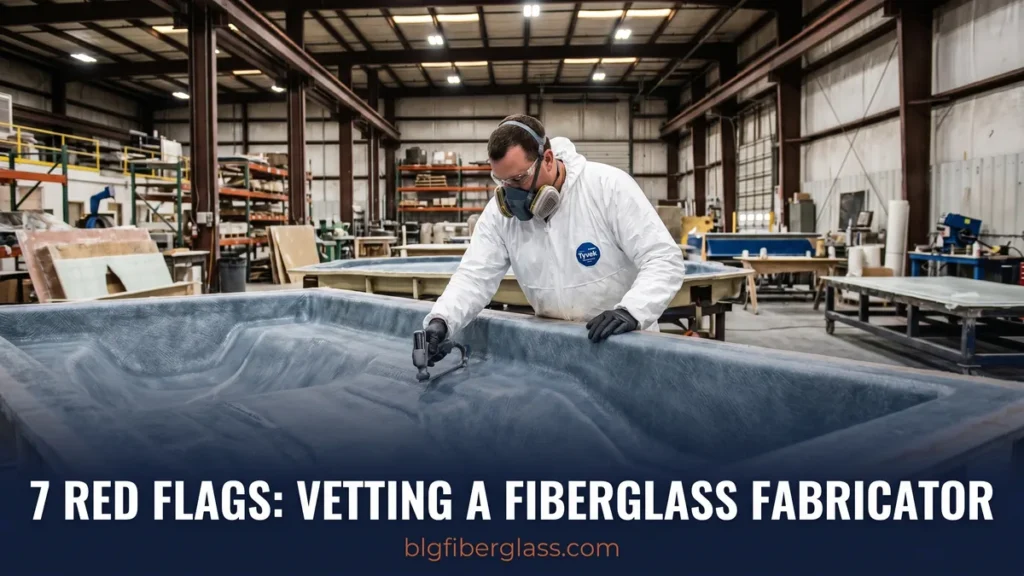
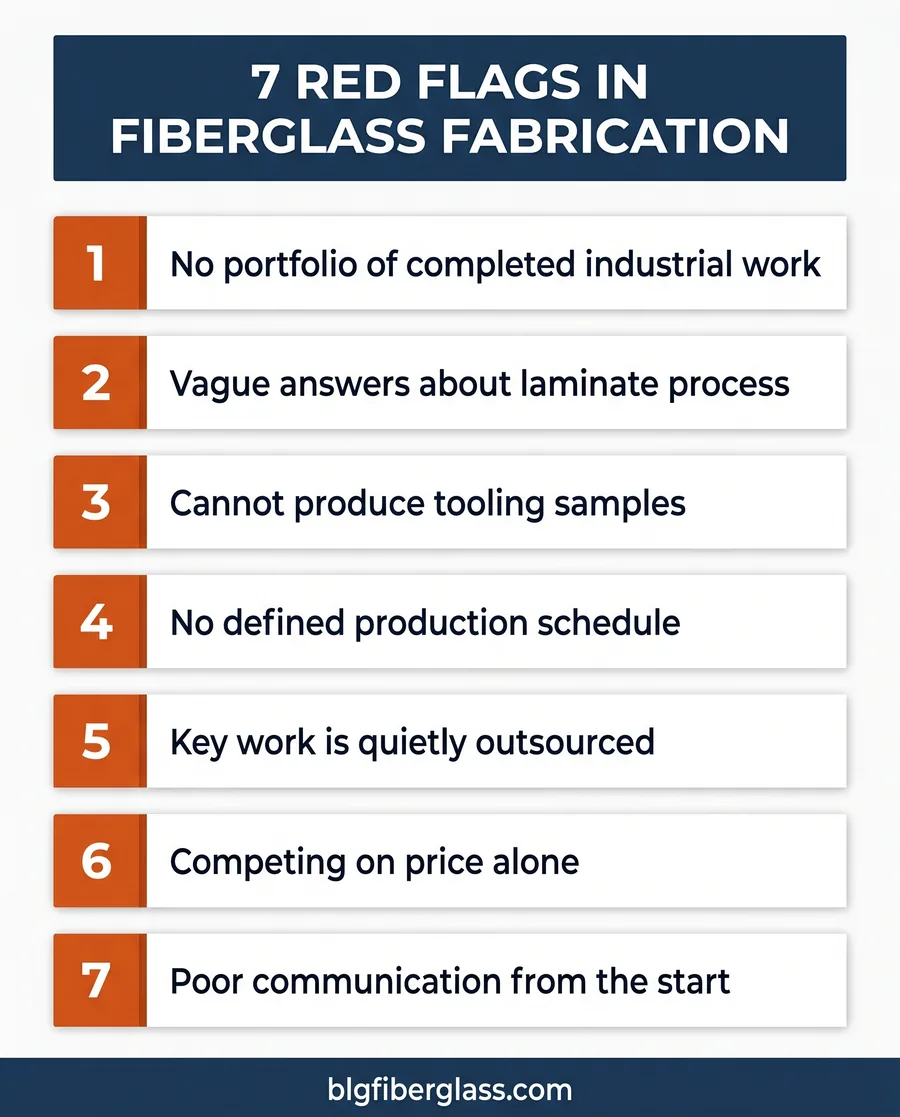
The 7 major red flags when vetting a custom fiberglass fabricator include: lacking a portfolio of industrial work, providing vague answers about their process, refusing to produce tooling samples, having no defined production schedule, quietly outsourcing key work, competing on price alone, and exhibiting poor communication.
What fabricators say vs. what they do
Every shop you contact will describe itself as experienced, quality-focused, and capable of handling your scope. That is not a differentiator, it is boilerplate. The buyers who get burned are the ones who take those statements at face value rather than testing them. The vetting process is about applying pressure to the claims before a contract applies pressure to your budget.
People often ask
How do I know if a fiberglass fabricator is actually capable of my project scope? The most direct answer: ask them to show you a completed part in a similar material and complexity. A fabricator who cannot produce one recent example of relevant industrial work has answered your question already.
The 7 Red Flags at a Glance
- No portfolio: Cannot show relevant completed industrial projects.
- Vague process: Unable to provide specific laminate schedules or cure cycles.
- No samples: Refuses to create a test panel before full tooling begins.
- No schedule: Cannot provide a clear timeline with milestone dates.
- Hidden outsourcing: Subcontracts key fabrication steps without transparency.
- Price-only pitch: Quotes are suspiciously low without technical justification.
- Poor communication: Slow or evasive responses during the proposal stage.
Red flag 1: No portfolio of completed industrial work
A legitimate custom fabricator accumulates a body of work. If you ask for photos, case studies, or references from past industrial clients and the response is hesitation, vague promises, or “we keep client work confidential,” that is worth noting. Confidentiality is reasonable. Having no documentation of any completed work is not.
What you are looking for specifically: evidence of work at a comparable scale, in materials close to what you need (gel coat tooling, chopped strand mat laminates, vacuum infusion, RTM, or structural FRP depending on your application), and for industrial applications rather than hobby or marine one-off builds. A shop that fabricates recreational boat hulls is not the same as a shop that produces repeatable, dimensionally consistent FRP enclosures for industrial applications.
Did you know
According to CompositesWorld, the majority of composite fabrication defects traced back to root cause analysis point to laminate schedule deviations during production, not raw material failures. A fabricator without documented quality procedures is unlikely to catch these deviations before parts leave their facility.
Red flag 2: Vague or evasive answers about process
Ask any fabricator three specific questions about how they plan to execute your job: What laminate schedule are you planning? How do you control fiber-to-resin ratio? What is your cure cycle and how do you verify it? A competent shop will give you specific, technical answers. An underqualified one will offer reassurance instead of information.
This matters most on structural or precision parts where laminate thickness, fiber orientation, and cure completeness determine whether the part functions or fails. “We have been doing this for years” is not a process answer. Neither is “we follow industry standards” without specifying which ones. ASTM composite standards are publicly available, and a fabricator who cannot cite the relevant ones probably is not applying them.
Red flag 3: Can’t produce tooling samples or test panels
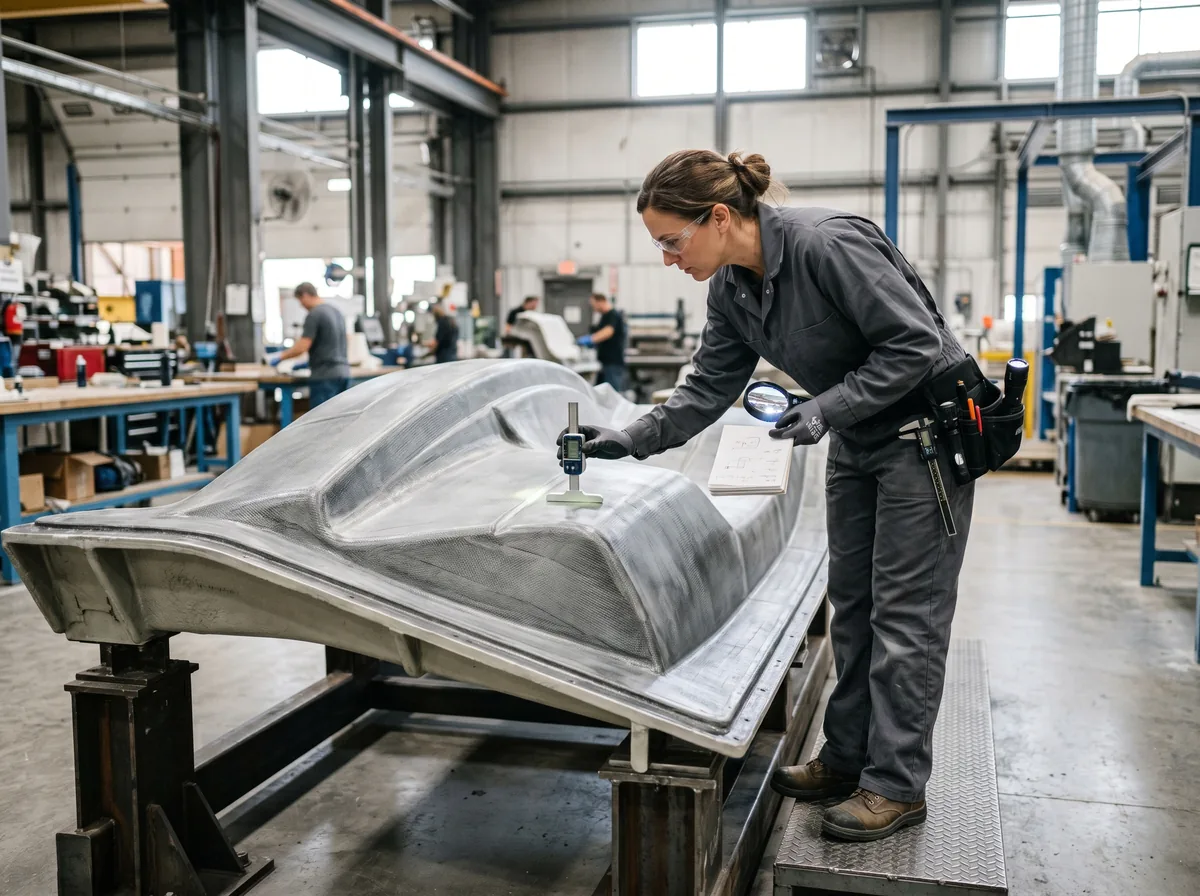
Before committing to a full mold build, any serious fabricator should be able to produce a small test laminate from the material and process combination you need. This is not an unusual ask. It is standard practice in aerospace, automotive tooling, and industrial FRP. If a fabricator cannot or will not produce a test panel, the risk of discovering process deficiencies on your actual production mold is entirely yours.
What a good test panel evaluation includes: surface finish consistency, edge definition, void content (visually or by ultrasonic scan if the application warrants it), dimensional conformance to the drawing, and cure state verification. None of this is exotic. It is the baseline quality evidence that should exist before you hand over significant tooling budget.
Pro tip
Request a test laminate in the actual resin system you plan to use, not a demonstration panel in whatever the shop has on hand. Fabricators optimized for polyester open-mold work do not automatically have the process controls for vinyl ester or epoxy infusion. The test panel reveals the real capability.
Red flag 4: No defined production schedule
A fabricator who cannot give you a milestone schedule with rough dates at proposal stage has not thought through your job in any real detail. Build time, cure time, finishing and inspection, and delivery are not vague estimates, they are predictable from experience. If the answer to “when can I expect the first article?” is “it depends” or a timeline that seems implausibly short, both responses are warning signs.
Implausibly short timelines are actually the more dangerous version. An aggressive commitment to win the business often results in either a rushed job with quality shortcuts or a fabricator who quietly misses the date and then adds several weeks of unannounced delay. Ask for a written schedule breakdown and pay attention to whether it accounts for cure time, post-processing, and any tooling qualification steps your application requires.
Red flag 5: Key work is quietly outsourced
Some shops present as a full-service fabricator but subcontract significant portions of the work, particularly gel coat finishing, structural lamination, or CNC trimming, to third parties without disclosing it. This is not automatically a disqualifier. Plenty of legitimate fabricators use subcontractors for specific processes. What matters is transparency.
The problem is accountability. If a defect appears in a subcontracted operation, you are now in a triangle: your fabricator, their subcontractor, and you. Ask directly: what operations do you perform in-house, and what is subcontracted? Get the answer in writing. A fabricator who hides subcontracting is either embarrassed by it or aware that you would make a different choice if you knew.
Red flag
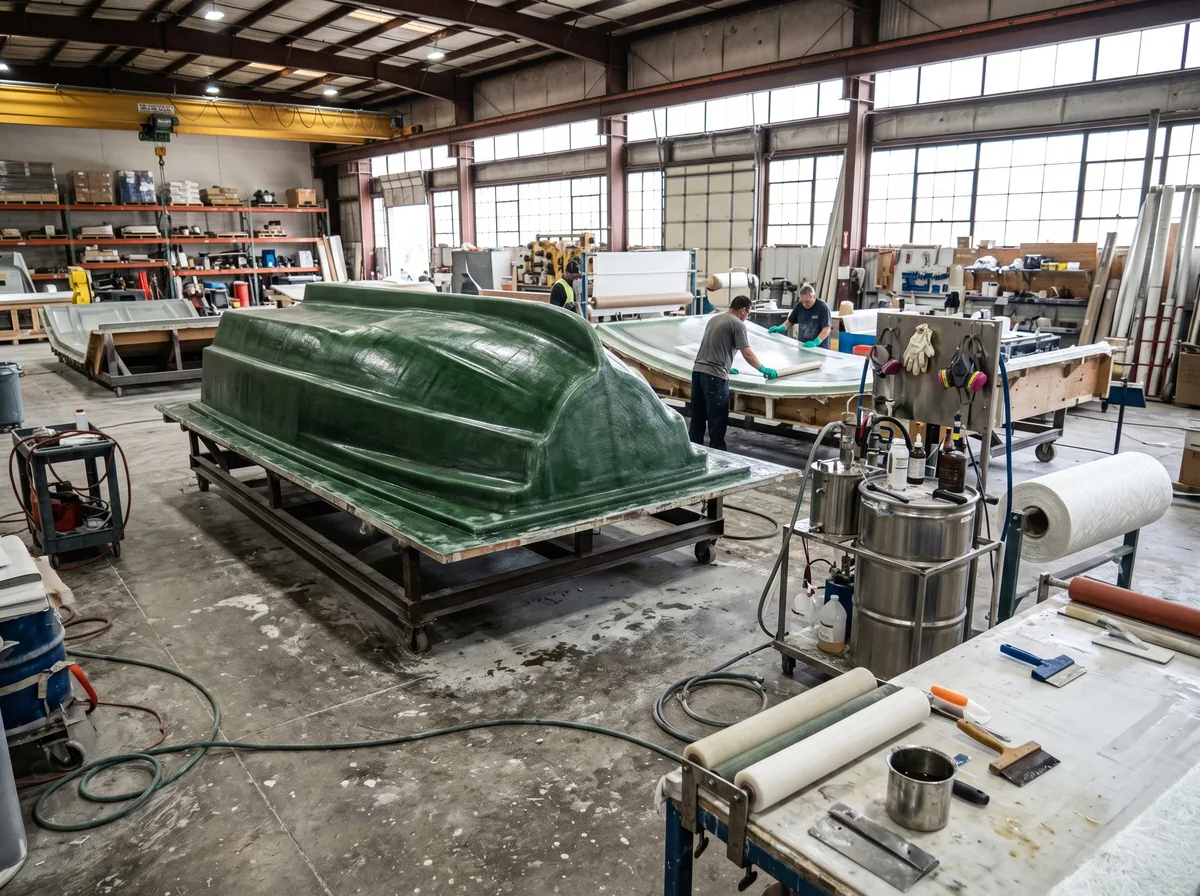
If your fabricator is evasive about which operations happen on-site versus off-site, request a facility tour before signing. An in-person visit to the shop floor reveals equipment capability, workforce size, and process discipline in about 30 minutes. A shop with nothing to hide will welcome the visit.
Red flag 6: Competing on price alone
A quote that comes in 30 to 40 percent below competing bids without a corresponding explanation of how that cost is achieved is a risk, not a win. Fiberglass fabrication costs are driven by material, labor hours, tooling quality, and process controls. Cutting any of these meaningfully cuts the outcome.
The most common forms of cost-cutting that are invisible at proposal stage: thinner laminate schedules, lower-grade reinforcement fabrics, insufficient tooling coat thickness, compressed cure cycles, and reduced QA inspection. None of these show up in the quote. They show up in service life, dimensional repeatability, and warranty claims. If a fabricator cannot explain the cost difference in specific technical terms, the difference is coming from somewhere.
Red flag 7: Poor communication from the start
How a fabricator communicates during the sales process is almost always a preview of how they communicate during production. If responses to your RFQ are slow, questions go unanswered, or you are handed off to a junior contact who has not reviewed your drawings, the production relationship will be worse, not better.
Custom fiberglass fabrication requires ongoing technical dialogue. Material availability, design for manufacturability feedback, first article review, and delivery updates all depend on a supplier who communicates proactively and specifically. A shop that cannot manage a clean proposal exchange is not going to manage a complex tooling project smoothly.
Save your money
Invest time in the vetting process upfront. A thorough evaluation takes a few extra days before contract. Discovering the wrong choice after tooling has started costs weeks and anywhere from $10,000 to $80,000 in sunk tooling costs depending on mold complexity. The evaluation period is the cheapest insurance available.
How to vet a custom fiberglass fabricator properly
Once you know what to avoid, the positive version of the vetting process becomes clearer. A capable fabricator should be able to do all of the following without hesitation.
- Provide a relevant portfolio. Completed industrial work in comparable materials and applications, with contact references if requested.
- Answer technical questions specifically. Laminate schedules, resin systems, cure cycles, and QA procedures should be described in specific terms.
- Produce a test panel. A sample laminate in your material and process combination before full tooling commitment.
- Deliver a written schedule. Milestone dates for tooling, first article, and production delivery with stated assumptions.
- Disclose subcontracting honestly. Which operations are in-house and which are not, in writing.
- Justify their pricing. If they are cheaper than competitors, they should be able to explain why specifically.
- Respond promptly and specifically. Questions addressed by a technically informed contact within a reasonable timeframe.
BLG Fiberglass works with industrial and commercial clients on custom fiberglass molds, FRP parts, and specialty fabrication. Every project begins with a technical consultation to review drawings, discuss process options, and confirm feasibility before any commitment is made.
Download the free quick guide
A printable checklist of the seven red flags and the positive qualification criteria, formatted for use in your supplier evaluation process.
Frequently asked questions
BLG Fiberglass fabricates custom molds, FRP structural parts, and specialty composite components for industrial and commercial applications. If you are evaluating fabricators for an upcoming project, start with a technical consultation to discuss your drawings, material requirements, and timeline.
