

In this article
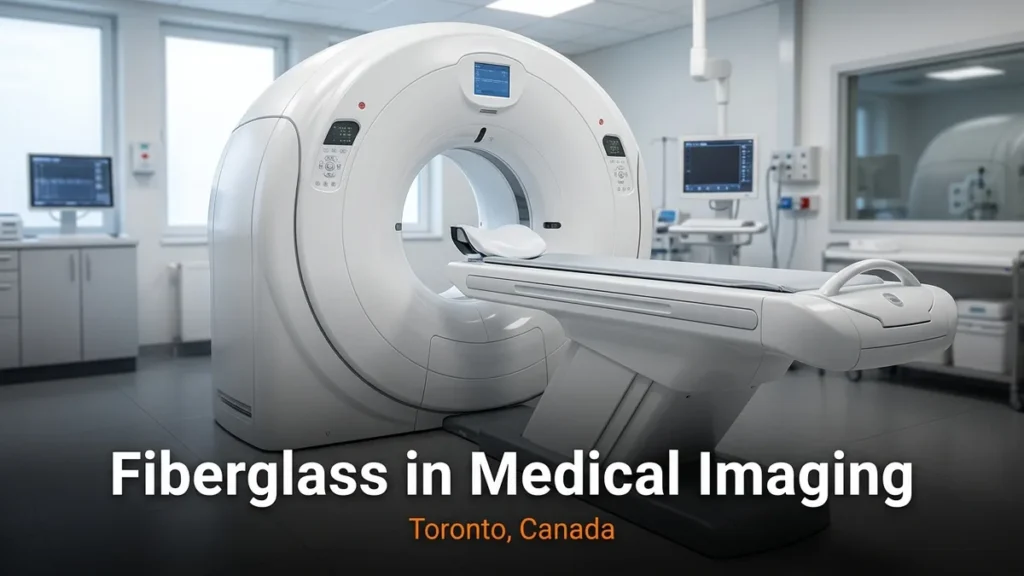
Fiberglass medical equipment housings are everywhere in clinical environments, but most people never notice them. The smooth white shell surrounding an MRI machine, the curved enclosure on a CT scanner, the protective casing on ultrasound units: these are almost universally made from fiberglass-reinforced plastic (FRP), not metal or standard thermoplastic. BLG Fiberglass manufactures fiberglass medical enclosures from our Toronto facility, and the reasons the industry standardized on this material are worth understanding if you are specifying a housing for diagnostic or therapeutic equipment.
Fiberglass (FRP) is the standard material for medical equipment housings—such as MRI and CT scanners—because it offers unmatched radio-frequency (RF) transparency, non-magnetic properties, large-scale dimensional stability, and a smooth, easily cleanable surface that meets strict healthcare sanitation requirements.
Why medical equipment uses fiberglass
Fiberglass became the dominant housing material for medical imaging equipment not because of any single property, but because it satisfies a combination of requirements that no alternative matches cleanly. Steel is too heavy and electromagnetically problematic. Standard thermoplastics can meet some requirements but fall short on dimensional stability at the scale of large imaging housings. Fiberglass fills the gap.
The core requirements that fiberglass meets for medical applications include radio-frequency transparency, dimensional stability at large scales, a smooth cleanable surface, sufficient structural stiffness for equipment that may weigh hundreds of kilograms, and the ability to be formed into complex ergonomic curves that make clinical environments feel less industrial. No other material checks every box at comparable cost.
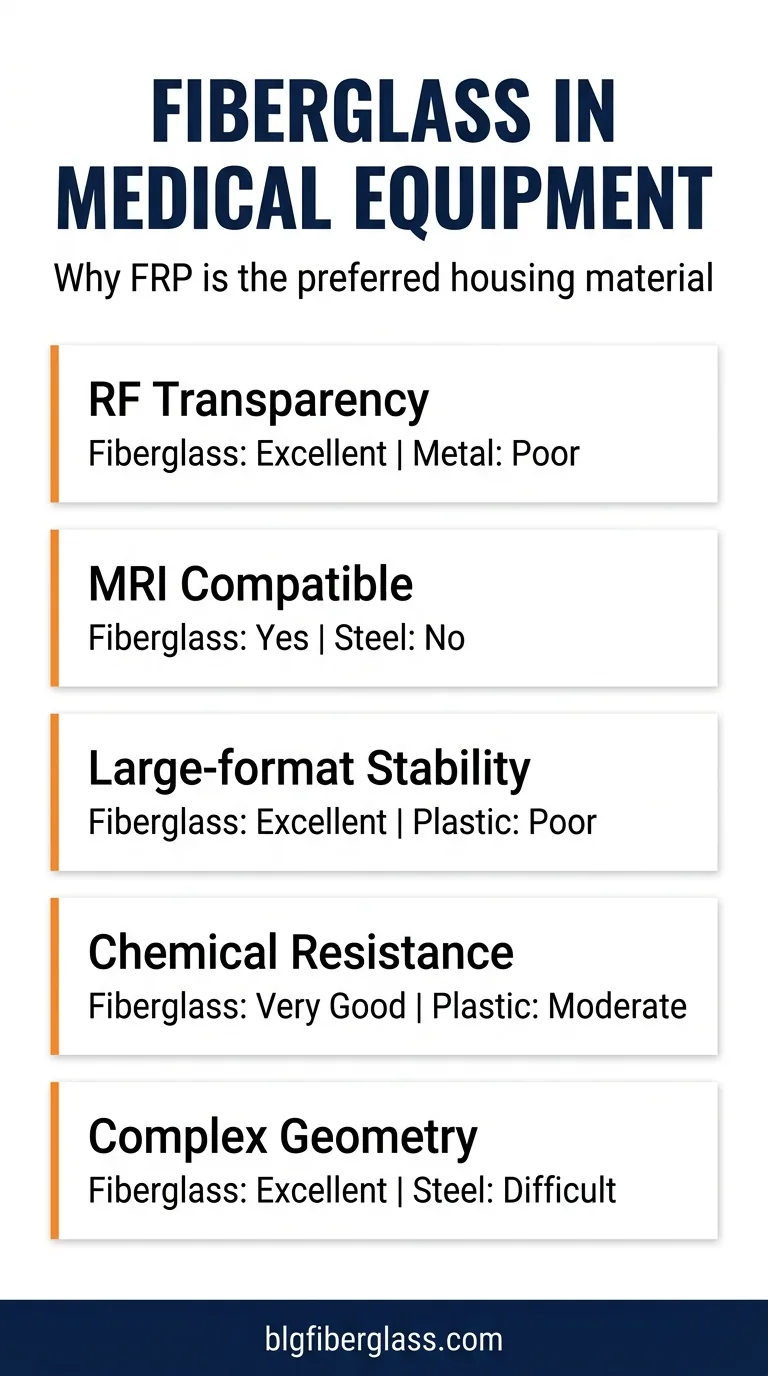
5 Reasons Fiberglass is Used in Healthcare
- RF Transparency: Does not interfere with MRI radio-frequency signals.
- Non-Magnetic: Contains no ferrous metals, eliminating projectile hazards in MRI rooms.
- Dimensional Stability: Holds complex shapes at large scales without warping or creeping.
- Chemical Resistance: Gel-coated surfaces withstand harsh hospital-grade disinfectants.
- Structural Stiffness: Supports heavy patient loads and maintains strict alignment tolerances.
Did you know?
A typical 1.5-tesla MRI machine generates a magnetic field roughly 30,000 times stronger than Earth’s magnetic field. Any ferromagnetic metal in the patient bore area is not just a nuisance; it becomes a projectile hazard. Fiberglass composites contain no ferrous metals, making them essential for MRI bore liners and inner housings.
RF transparency and MRI compatibility
MRI machines work by emitting radio-frequency pulses and detecting the signal returned by hydrogen atoms in body tissue. Any conductive or ferromagnetic material inside the bore or near the RF coil attenuates that signal, distorts the image, or generates artifacts that make diagnostics unreliable. This is not a marginal concern. A metal screw in the wrong location can render an MRI image clinically unusable.
Fiberglass-reinforced plastic is inherently RF-transparent. The glass fibers are dielectric, meaning they do not conduct electricity. The resin matrix is similarly non-conductive. A well-designed fiberglass component introduces essentially zero signal interference inside an MRI bore. Carbon fiber composites, by contrast, are electrically conductive and are generally excluded from the MRI bore region for this reason.
People often ask: can fiberglass composites be used inside an MRI bore?
Yes. Fiberglass FRP is one of the only structural materials that can be used inside or adjacent to the MRI bore without image interference. It is non-ferrous, non-conductive, and dimensionally stable under the temperature and humidity conditions typical of MRI suites. Manufacturers use fiberglass for bore liners, patient table surfaces, and inner housing structures specifically because of these properties.
Key fiberglass medical applications
Medical equipment manufacturers use fiberglass across a wider range of components than most purchasing teams realize. The most visible applications are the large housings on imaging equipment, but the material appears throughout the clinical environment.
MRI machine housings and bore liners
The exterior shell and bore liner of an MRI machine are the most demanding fiberglass applications in medical manufacturing. The bore liner must maintain dimensional accuracy across temperature swings generated by gradient coil heating, must not introduce RF artifacts, and must present a smooth surface that the patient lies adjacent to for up to an hour. Fiberglass manufactured with tight quality control satisfies all three. Typical bore liners are made from woven glass fabric in an epoxy or vinyl ester matrix, laminated to achieve target stiffness with minimum weight.
CT scanner housings
CT scanner housings do not have the same MRI compatibility constraint, but the design requirements are still demanding. The housing must be rigid enough to maintain gantry alignment tolerances while being light enough that two technicians can manage the assembly during installation. The outer surface must be non-porous and cleanable with hospital-grade disinfectants without degrading. Fiberglass housings meet these requirements and can be produced in large one-piece sections that eliminate visible seams, which collect bacteria and complicate cleaning protocols.
Patient table and couch surfaces
MRI and CT patient table surfaces are almost universally carbon-free fiberglass laminates. The table must support patient weights up to 250 to 300 kg over a cantilevered span, must be RF-transparent, and must present a smooth, low-friction upper surface. Fiberglass with a gel coat finish achieves the necessary combination of stiffness, surface quality, and RF performance. For CT applications where X-ray attenuation matters, low-density glass fabric systems are specified to minimize beam hardening artifacts.
Radiation therapy and linear accelerator components
Linear accelerators (LINACs) used for radiation therapy require treatment head covers and patient positioning aids that are transparent to therapeutic X-ray beams. Fiberglass composites have low X-ray attenuation compared to metals, and they can be fabricated in the complex curved forms needed for treatment head geometry. Patient immobilization masks and bolus materials also rely on the formability of composite systems.
Ultrasound and portable diagnostic equipment
Portable diagnostic equipment needs housings that are light, impact-resistant, and easy to disinfect between patients. Fiberglass handles impact better than most thermoplastics at the same wall thickness, and unlike metal, it does not add mass that makes portable units difficult to reposition. Hand lay-up and RTM both produce viable housings for this category; the choice depends on production volume and whether both surfaces need a finished appearance.
Pro tip
When specifying fiberglass for an MRI application, confirm with the composite manufacturer that no metallic fibers, carbon fiber, or conductive fillers are used in the laminate or gel coat. Even small quantities of electrically conductive material in a gel coat pigment can cause unexpected image artifacts. Request material data sheets and MRI compatibility test reports from the manufacturer.
Material properties that matter in healthcare
Specifying materials for medical equipment is more constrained than industrial applications. The regulatory environment, the cleaning chemicals used in clinical settings, and the patient-contact considerations all impose requirements that do not exist in automotive or marine work. Here is how fiberglass performs against the criteria that actually matter in a healthcare context.
| Property | Fiberglass FRP | ABS / PC thermoplastic | Stainless steel |
|---|---|---|---|
| RF transparency | Excellent | Good | Poor (reflective) |
| MRI compatibility | Excellent | Good | Not compatible |
| Chemical resistance | Very good with gel coat | Moderate | Excellent |
| Weight | Low to medium | Low | High |
| Large-format dimensional stability | Excellent | Poor (creep, warp) | Excellent |
| Complex curved geometry | Excellent | Good (thermoforming) | Difficult, expensive |
The combination of RF transparency, large-format dimensional stability, and formability into complex curves is where fiberglass has no direct competitor in medical equipment manufacturing. Thermoplastics warp at large scales. Steel is ferromagnetic. Fiberglass addresses all three limitations simultaneously.
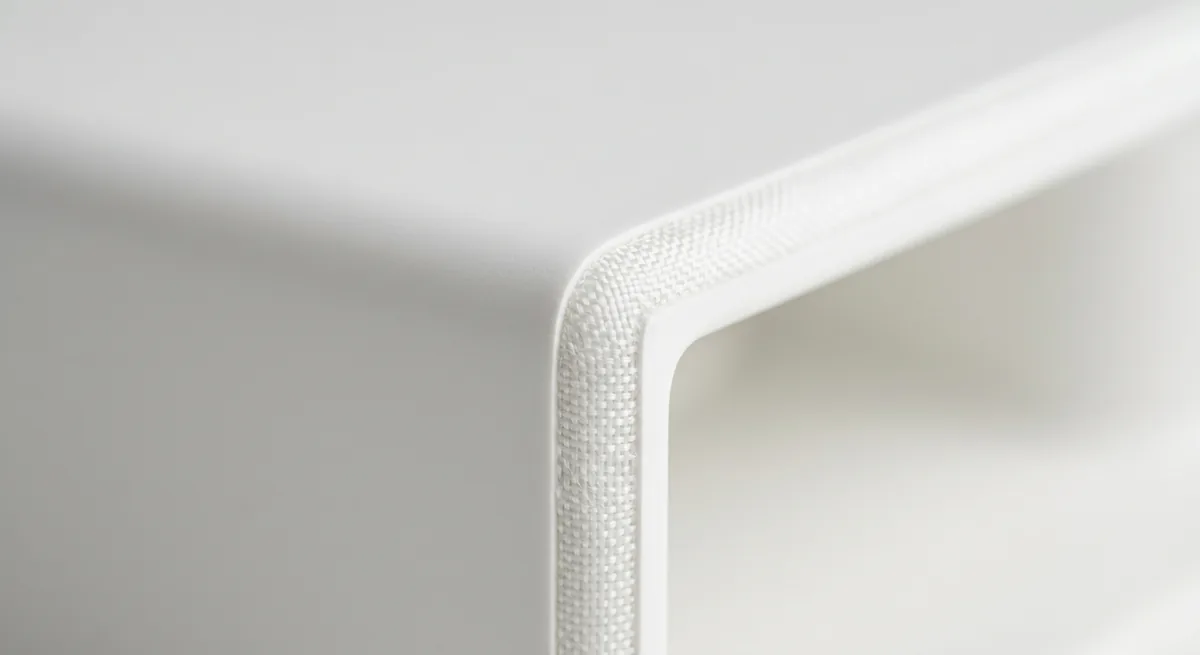
Manufacturing process for medical housings
Medical equipment housings are typically produced using one of three processes, chosen based on production volume, surface requirements, and geometry complexity.
Hand lay-up for low volumes and prototypes
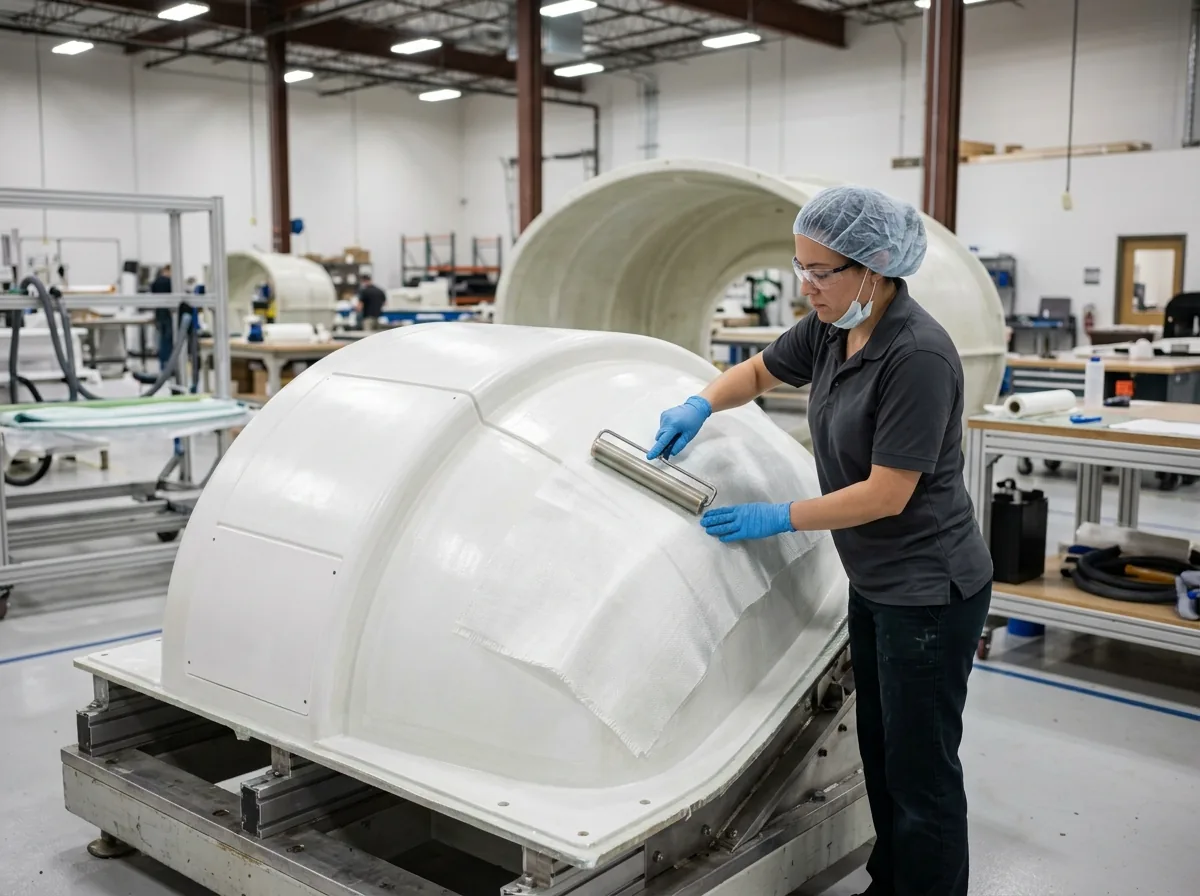
For prototype housings, custom single installations, or low-volume medical devices where 1 to 50 units per year is the target, hand lay-up FRP is the most practical approach. Tooling costs are lower, lead times are shorter, and design changes between generations are less costly. Surface finish on the mold-face side is controlled by the gel coat; the back face requires secondary finishing if both sides need a clinical appearance.
RTM for mid-volume with closed-mold surface quality
When the housing needs finished surfaces on all visible faces and volume justifies the tooling investment, resin transfer molding is the preferred process. The closed mold produces consistent wall thickness, eliminates the variable surface quality of hand lay-up, and reduces worker exposure to styrene. For an imaging equipment housing running 200 to 2,000 units per year, RTM typically offers the best balance of quality and economics.
Vacuum forming for non-structural panels
Non-structural cover panels, access doors, and trim components on medical equipment are frequently produced by vacuum forming in ABS or high-impact polystyrene. These materials do not offer the structural performance or RF transparency of fiberglass, but for cosmetic panels that carry no structural load and are not adjacent to MRI RF coils, they provide a cost-effective option with fast cycle times.
People often ask: what certifications does fiberglass need for medical equipment?
Medical equipment housings typically need to meet IEC 60601-1 for electrical safety (relevant to materials in patient-accessible zones), ISO 10993 biocompatibility testing if there is any patient contact, and UL 94 flame ratings (usually V-0 for housings in electrical equipment). The composite manufacturer should provide material certifications and be able to support the OEM’s regulatory submission with documented material data. Gel coat selection matters: some pigments contain trace metals that can cause MRI artifacts or fail biocompatibility screening.
Download: Fiberglass Medical Equipment Specification Guide
Material properties, MRI compatibility checklist, disinfection guide, and manufacturing process selection. Free PDF.
Frequently asked questions
BLG Fiberglass produces custom fiberglass medical equipment housings from our Toronto manufacturing facility. Whether you are developing a new diagnostic platform or need a production supplier for an established device, our team can assess your geometry, volume, and regulatory requirements and recommend the most appropriate manufacturing approach. Use our project inquiry form to start the conversation.
If you are comparing fiberglass manufacturers for a US order, BLG handles the customs paperwork, duty treatment and freight into the US.
