

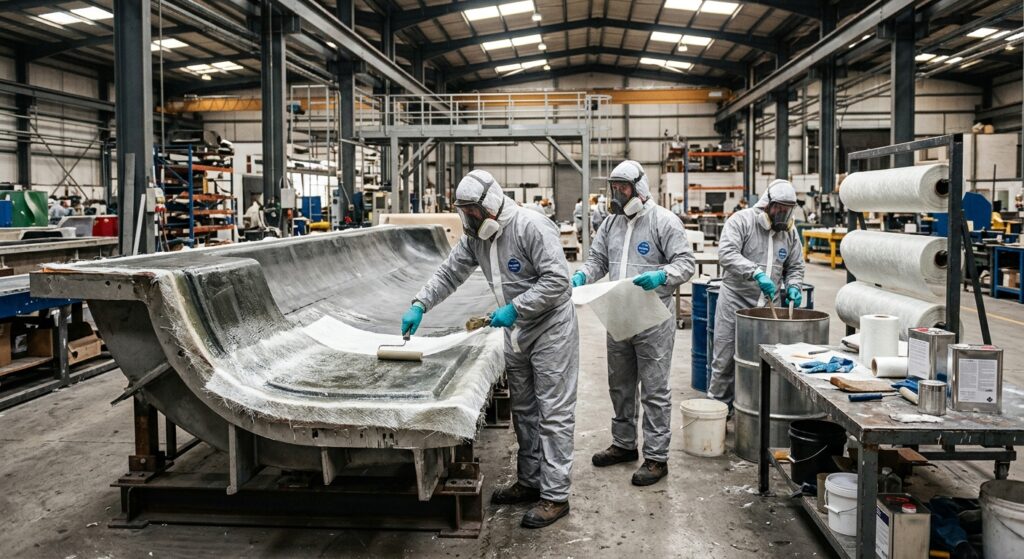
Hand lay-up is the oldest and most widely utilized method for engineering fiberglass reinforced plastic (FRP) components. From marine hulls to medical enclosures, it remains the standard for creating complex structural geometries. Understanding the exact chemistry and physical mechanics behind this open-mold lamination technique is critical for ensuring structural integrity.
Table of Contents
The Physics of Manual Lamination
At its core, manual laminating is a wet-on-wet architectural process. It relies on impregnating dry, fibrous reinforcement fabrics with a catalyzed liquid polymer matrix. Unlike automated thermoforming, manual lamination happens at standard atmospheric pressure. The integrity of the composite relies entirely on the technician’s ability to mechanically force the liquid matrix into the microscopic voids between the individual glass filaments before the polymer begins its exothermic cross-linking (curing) phase.
The Step-by-Step Chemical and Physical Process
Transforming raw liquid and dry textiles into a rigid structural component requires precise sequential execution:
1. Tooling Preparation: The rigid mold surface is chemically cleaned and coated with a specialized parting wax or PVA (Polyvinyl Alcohol) release agent. This prevents the catalyzed polymer from permanently bonding to the tooling.
2. Gel Coat Application: An initial layer of highly resilient, pigmented resin (gel coat) is applied directly to the mold. This creates the primary environmental and UV barrier for the component.
3. Matrix Impregnation: Dry reinforcement textiles are placed into the mold. Technicians manually apply the catalyzed liquid matrix (resin mixed with an initiator like MEKP) using specialized grooved bristle rollers.
4. Void Consolidation: This is the most critical mechanical step. The grooved rollers are aggressively worked across the wet laminate to force out trapped air bubbles. Air voids act as stress concentrators that can cause catastrophic delamination under load.
5. Exothermic Curing: As the initiator reacts with the resin, a chemical cross-linking process occurs, generating significant internal heat (exotherm). The part must remain undisturbed in the mold until it fully polymerizes and cools to ambient temperature.
Reinforcement Architecture and Matrix Resins
The structural limits of the component are defined by the specific combination of reinforcement architecture and polymer chemistry.
Reinforcement Textiles
- Woven Roving: Heavy continuous strands woven at 90-degree angles. Provides massive tensile strength along the specific warp and weft axes.
- Non-Crimp Fabrics (Biaxial/Triaxial): Fibers are stitched together flat rather than woven. This prevents the fibers from “crimping” or bending over one another, yielding a stiffer, stronger laminate under high stress.
Matrix Chemistry
- Polyester Matrix: The industry standard. Provides excellent wetting characteristics and reliable ambient-temperature curing profiles.
- Vinyl Ester Matrix: Features a modified molecular chain that absorbs dynamic impacts better than polyester. It provides superior hydrolytic stability (blister resistance) in continuous submersion marine environments.
- Epoxy Matrix: Delivers the ultimate mechanical adhesion and lowest shrinkage rates during the exothermic cure. Requires highly precise mix ratios to achieve full polymerization.
Non-Destructive Testing (NDT) & Quality Assurance
Because the physical compaction is done by hand, professional FRP engineers rely on rigorous Non-Destructive Testing (NDT) to verify the internal stability of the cured laminate.
Barcol Hardness Testing: Technicians press a specialized penetrometer into the cured surface. This verifies that the chemical exotherm was completely successful and the resin has reached its maximum designed hardness.
Ultrasonic Phased Array: High-frequency sound waves are pulsed through thick laminates. The returning echoes map the internal structure, allowing engineers to detect invisible dry spots, air voids, or micro-delaminations hidden deep beneath the surface.
Technical FAQ
How thick can a manually laminated part be?
There is no physical limit, but there is a chemical limit per session. Because the curing process generates intense exothermic heat, laying up too many plies at once can cause the resin to boil, scorch, or crack. Very thick laminates (like 40mm marine transoms) must be laid up in carefully timed, sequential stages to allow thermal dissipation.
Why is temperature control critical during lamination?
The viscosity of the liquid matrix and the speed of the chemical cross-linking are highly temperature-dependent. A shop environment that is too cold will prevent the polymer from fully curing, while excessive ambient heat will cause the resin to “snap” (harden) before the technician has time to roll out the trapped air.
What causes a laminate to turn white in high-stress areas?
This is known as “crazing.” It indicates micro-failures within the polymer matrix. The microscopic resin bonds fracture under excessive flexing, separating from the glass filaments. This highlights the importance of engineering the correct glass-to-resin ratio during the wet-out phase.
If you are comparing fiberglass manufacturers for a US order, BLG handles the customs paperwork, duty treatment and freight into the US.
