

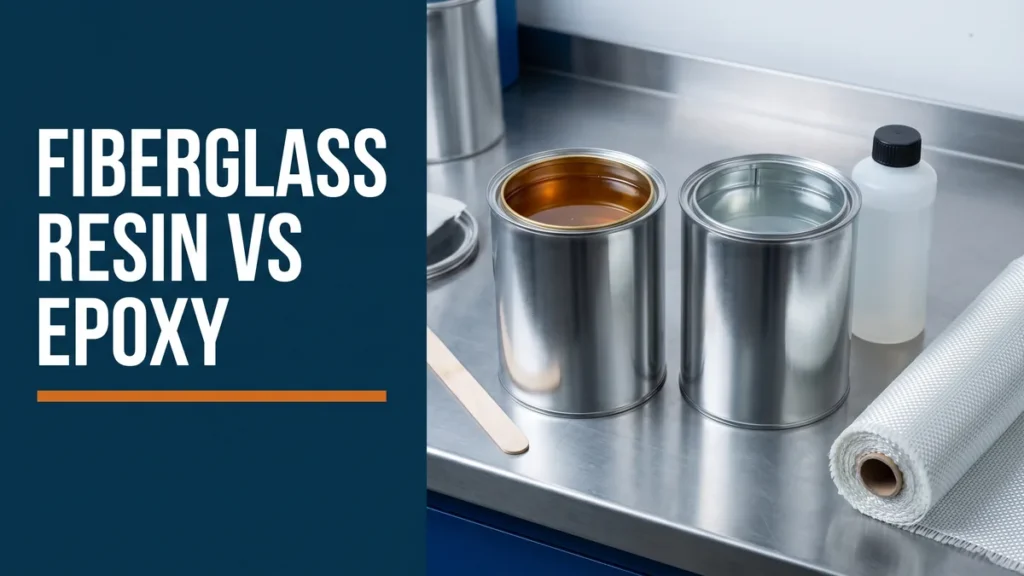
The short version of the fiberglass resin vs epoxy question is this: “fiberglass resin” almost always means polyester or vinyl ester resin, and epoxy is a separate chemistry that bonds harder, shrinks less, and costs more. For most production laminating we run at BLG, polyester does the job. For high-load bonding, repairs over cured laminate, and parts that cannot tolerate movement, epoxy earns its price. If you are speccing a part or a repair, the resin you pick changes strength, adhesion, and budget. See how the two behave in real hand lay-up FRP fabrication before you commit.
People use the two words as if they were interchangeable. They are not. Choosing the wrong one shows up later as poor adhesion, a tacky surface that never fully cures, or a part that flexes and cracks under load. Here is where the line sits and how to pick for your application.
In this article
What people mean by resin and epoxy
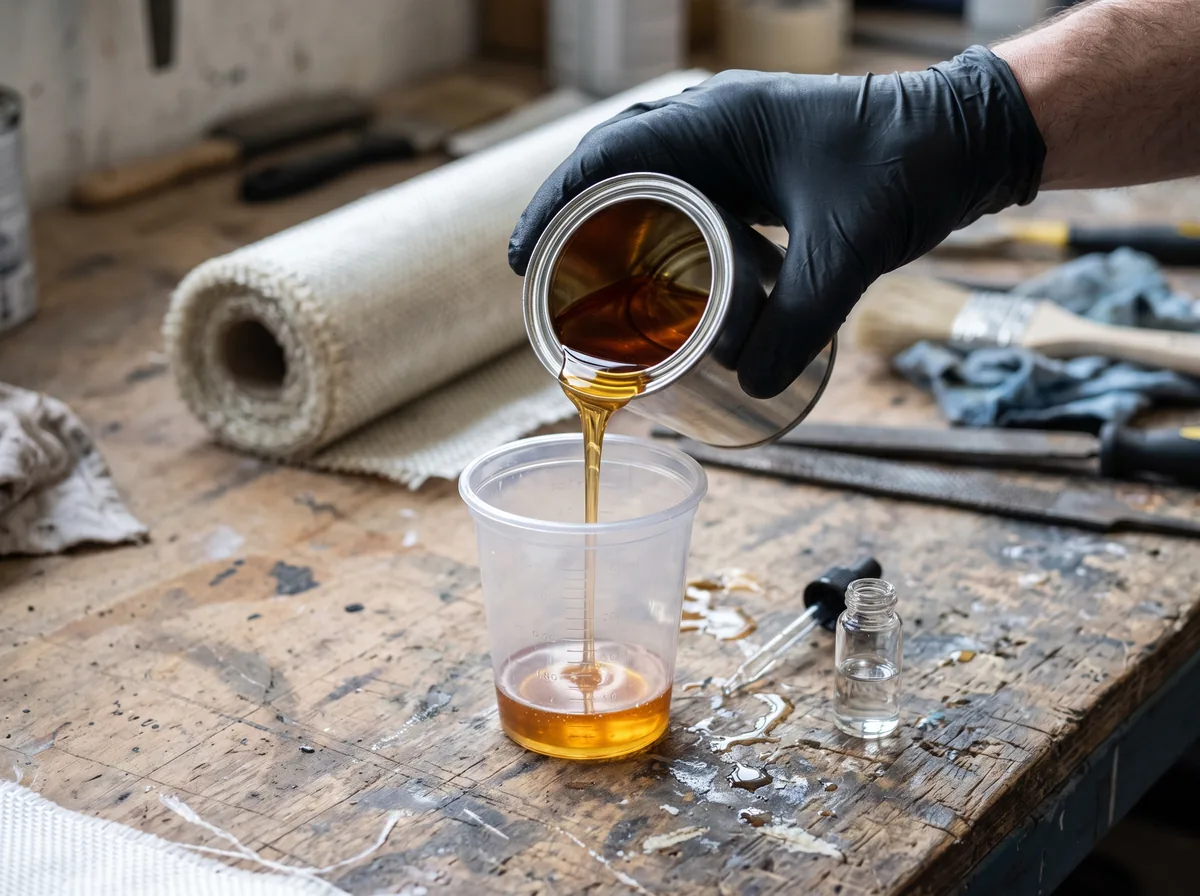
The confusion starts with the shop-floor shorthand. When someone at a marine yard or a body shop says “fiberglass resin,” they almost always mean unsaturated polyester resin, the amber liquid you catalyze with a few drops of MEKP hardener. It is the resin most people meet first because it is cheap, cures fast, and is sold in every auto parts store.
Epoxy is a different family entirely. It cures through a two-part reaction between a resin and a hardener mixed at a precise ratio, with no separate catalyst. It is what you reach for when the bond has to hold, when you are laminating over an already cured surface, or when dimensional stability matters. So the real comparison is not resin versus epoxy. It is polyester or vinyl ester resin versus epoxy resin, three chemistries that share a job but not a personality.
Quick take
“Fiberglass resin” usually means polyester. Epoxy is a separate two-part resin that bonds harder and shrinks less but costs two to three times as much. Vinyl ester sits between them on both price and performance.
Polyester and vinyl ester: the standard laminating resins
Polyester resin is the workhorse of open-mould fiberglass. It wets out glass fast, kicks off in minutes once catalyzed, and is inexpensive by the drum. That is why it dominates high-volume laminating, from boat hulls to shower pans to the spray-up and hand lay-up parts that fill a fabrication shop. The trade-off is that polyester shrinks noticeably as it cures, gives off styrene, and does not bond well to a surface that has already hardened.
Vinyl ester is polyester’s tougher cousin. It costs more but resists water, chemicals, and fatigue far better, which is why it shows up in corrosion tanks, ductwork, and the barrier coat on quality boat hulls. If you have ever wondered why an industrial tank spec calls out vinyl ester and a garden planter calls out polyester, the answer is service life in a harsh environment. Both cure through the same styrene-based reaction, so both bond best to fresh, still-green laminate.
Did you know
Polyester and vinyl ester both rely on a secondary bond to a cured surface, which is weaker than the primary bond you get while the laminate is still curing. That is exactly why so many polyester repairs peel: the patch was laid onto a fully cured, unsanded, contaminated surface it could never grip properly.
Epoxy: stronger bond, higher cost
Epoxy is the premium option, and it behaves like one. It forms a stronger mechanical and chemical bond than polyester, shrinks very little as it cures, and grips a cured surface far better, which makes it the default for structural repairs and secondary bonding. It also tolerates a wider range of reinforcements, including carbon fiber and aramid, where polyester struggles. For educational depth on epoxy performance, the WEST SYSTEM epoxy technical library is a solid reference used across the marine trade.
The catch is cost and process discipline. Epoxy runs two to three times the price of polyester, cures slower, and demands an accurate mix ratio measured by weight or volume, not eyeballed. Get the ratio wrong and it stays soft forever. It also will not accept a polyester gel coat over the top without special prep. So epoxy is not automatically better. It is better for specific jobs, and overkill for many others.
Pro tip
You can laminate polyester over cured epoxy only after the epoxy is fully cured, washed to remove amine blush, and sanded. You cannot reliably go the other way and expect a polyester gel coat to stick to raw epoxy. When in doubt, keep one chemistry through the whole part.
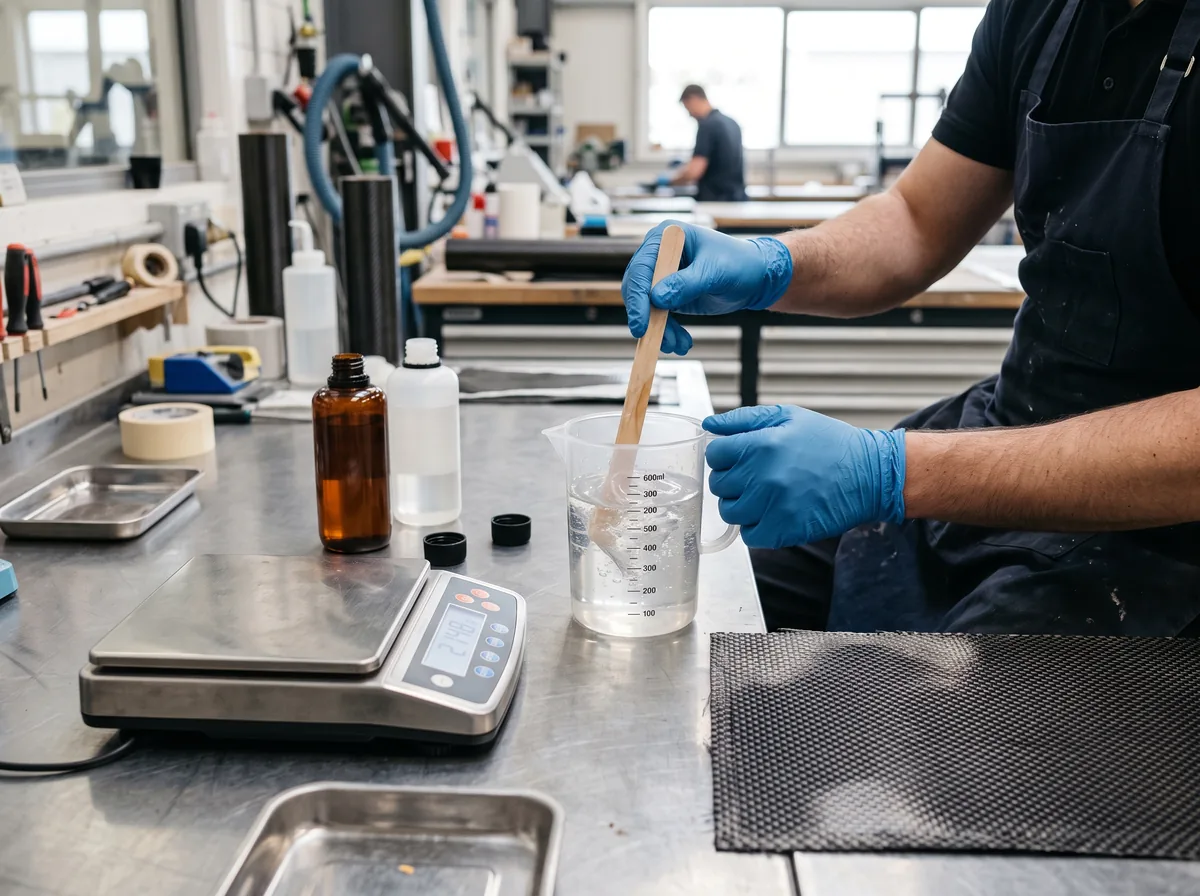
Fiberglass resin vs epoxy compared head to head
Numbers make the choice concrete. The table below sets polyester, vinyl ester, and epoxy side by side on the properties that actually drive a spec. Treat the cost column as relative, not a quote, since resin pricing moves with the market.
| Property | Polyester resin | Vinyl ester | Epoxy |
|---|---|---|---|
| Relative material cost | Lowest (1x) | Medium (1.5 to 2x) | Highest (2 to 3x) |
| Bond to cured laminate | Weak secondary bond | Weak to moderate | Strong secondary bond |
| Cure shrinkage | High | Moderate | Very low |
| Water and chemical resistance | Fair | Very good | Excellent |
| Working (pot) time | Short, minutes | Short to medium | Longer, adjustable |
| Best fit | High-volume laminating | Corrosion, marine hulls | Structural repair, bonding |
The figures above are general industry comparisons as of 2026 and describe typical behaviour, not a quote for any specific product. Actual properties vary by formulation, catalyst level, temperature, and manufacturer. Always confirm cure and performance data against the product data sheet and safety data sheet for the exact resin you are using.
Save your money
Do not default to epoxy because it sounds stronger. On a large production part that is not structural, polyester delivers most of the performance for a third of the resin cost. Spend the epoxy budget where it counts: bonds, repairs, and load paths. Matching resin to task is how a shop keeps a part affordable without cutting corners.
How to choose the right resin for the job
The guidance below is general and assumes standard shop conditions and proper ventilation. Resin selection for a load-bearing, pressure, or safety-critical part should be reviewed by a qualified composites engineer. BLG Fiberglass is not liable for outcomes from choices made on the basis of this article. Confirm every material against its data sheet.
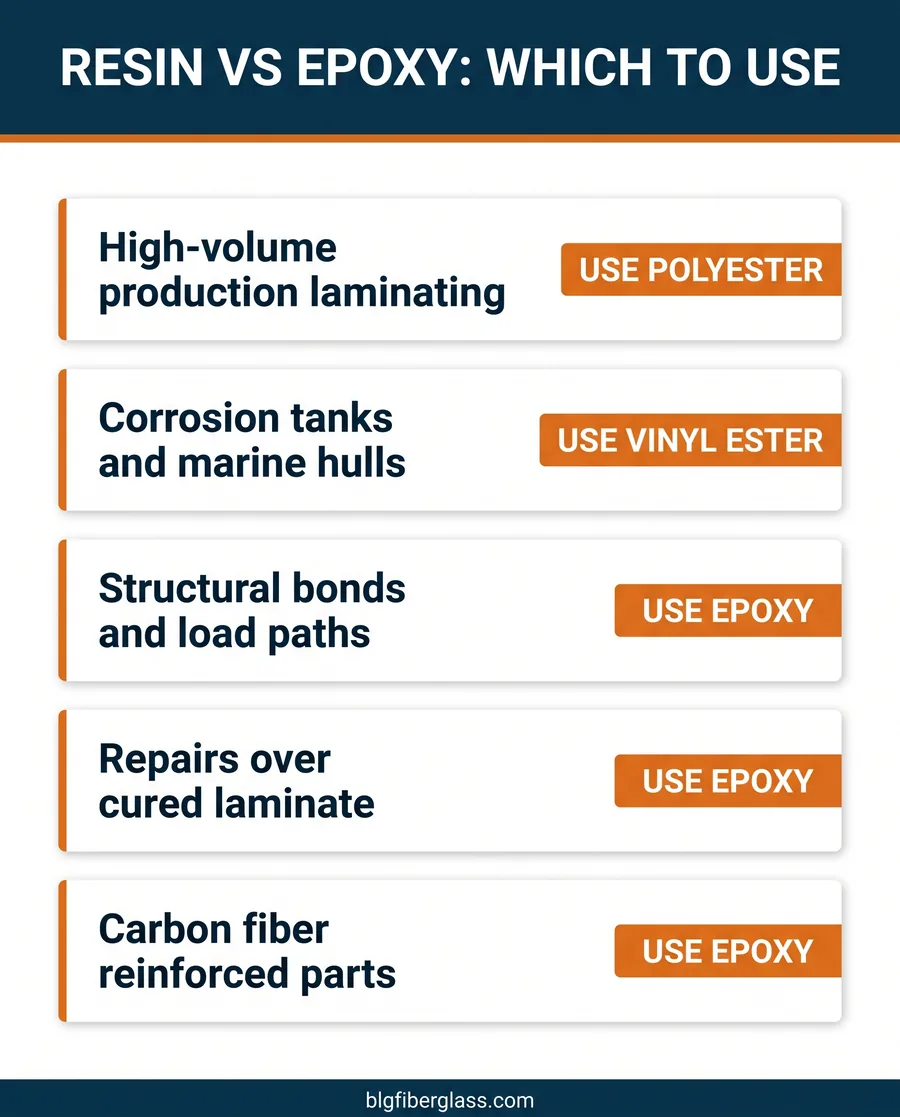
- Start with the load. If the part is structural or a bonded joint carries load, lean toward epoxy for its stronger bond and low shrinkage.
- Check the surface. Bonding to an already cured laminate, like most repairs, favours epoxy. Building a fresh laminate all at once favours polyester.
- Match the environment. Constant water, fuel, or chemical exposure points to vinyl ester or epoxy, not standard polyester.
- Weigh the volume. High-volume, cost-sensitive production usually means polyester, since epoxy cost and cure time add up fast.
- Consider the finish. A polyester gel coat pairs naturally with polyester or vinyl ester laminate, not with a raw epoxy surface.
- Confirm compatibility. Keep one resin family through a part where you can, and never mix hardeners or catalysts across chemistries.
People often ask: can I use epoxy over a polyester fiberglass part?
Yes, and it is often the better repair choice. Epoxy bonds well to a cured, sanded, and cleaned polyester laminate, which is why structural repairs frequently use it even on a polyester hull. The reverse is unreliable. A polyester resin or gel coat laid over raw epoxy may never fully cure. If you plan to gel coat afterward, prep the epoxy carefully or keep the whole repair in one chemistry.
“Learned the hard way that polyester will not stick to a cured repair. Sanded it back, switched to epoxy, and the patch has held for three seasons on a working boat.”
r/boatbuilding member, 2024
Handling, safety, and cure
Both chemistries demand respect. Polyester and vinyl ester release styrene vapour, which is why open-mould shops run serious ventilation and respiratory protection. Epoxy is lower in fumes but a known skin sensitizer, so repeated unprotected contact can trigger a lasting allergy. For workplace exposure guidance on styrene, the OSHA styrene safety resources set out the limits and controls professional shops follow.
Cure is the other place people trip. Polyester lives or dies by the right catalyst percentage and temperature. Epoxy lives or dies by an accurate mix ratio. Both cure poorly when cold. Get either wrong and the part stays soft, and no amount of extra time will fix a bad mix. When a part is structural or the finish has to be flawless, that margin for error is exactly why so much composite work belongs in a controlled shop.
Download the free quick guide
A one-page reference comparing polyester, vinyl ester, and epoxy on cost, bond, cure, and best fit.
Frequently Asked Questions
Not sure whether your part calls for polyester, vinyl ester, or epoxy? BLG Fiberglass builds custom FRP components for marine, automotive, and medical clients across Canada and the USA, and we spec the resin to the load, the surface, and the environment rather than a one-size default. Tell us about your part and we will point you to the right chemistry before a drop of resin is mixed.
If you are comparing fiberglass manufacturers for a US order, BLG handles the customs paperwork, duty treatment and freight into the US.
