


Quick take
Low volume wins when tooling cost would swamp a short run: prototypes, custom parts, very large single pieces, and products still changing. Cheap, flexible molds beat expensive precision tooling until quantity climbs.
When high-volume makes sense
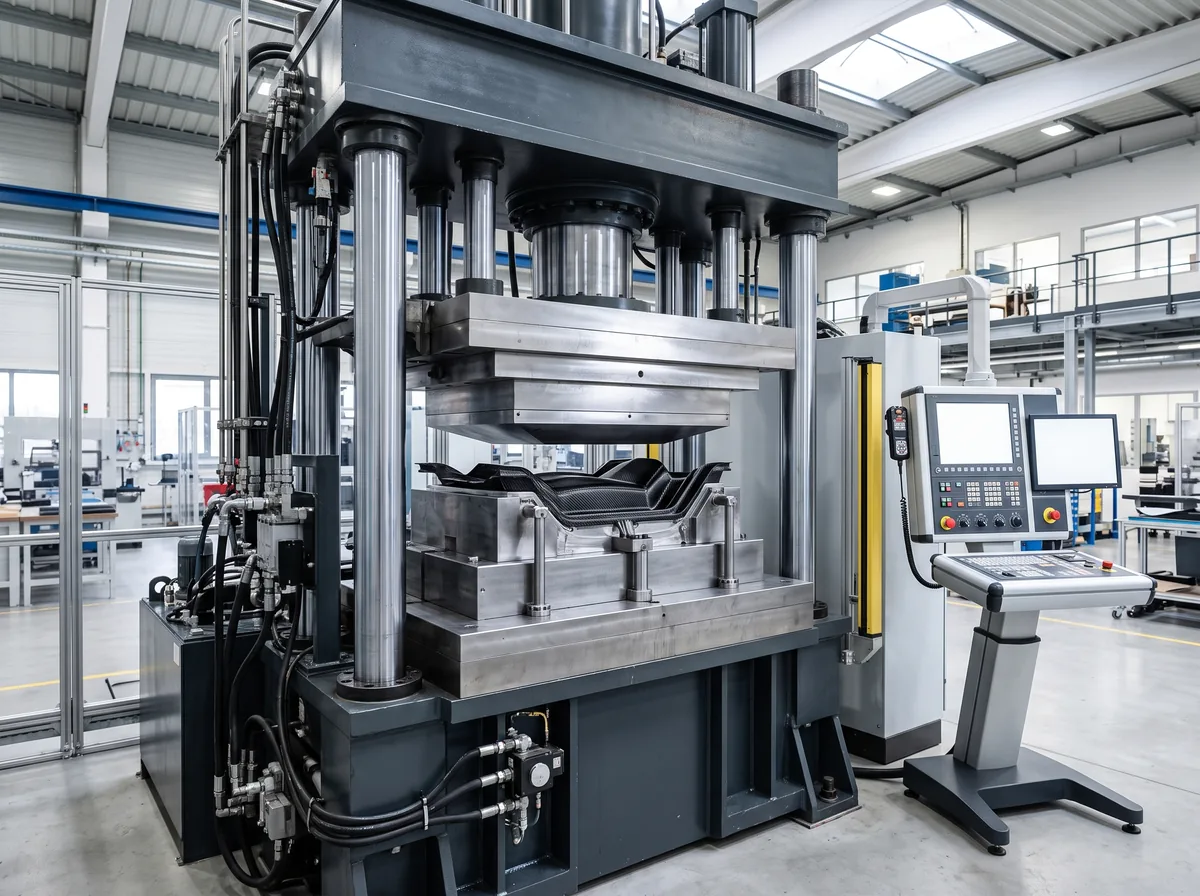
Once annual quantity climbs into the thousands, the math flips. Processes like sheet molding compound and compression molding use matched metal tooling and can turn out parts in minutes with tight repeatability and excellent surface finish on both sides. The tooling is expensive, but spread across tens of thousands of parts, the cost per unit drops well below anything hand lay-up can reach.
High volume also buys consistency. Automated closed-mold processes reduce the part-to-part variation that hand work introduces, which matters when a customer expects every unit to be dimensionally identical. If your product has stabilized and demand is real, this is where fiberglass manufacturing starts to look like true mass production. The Society of Manufacturing Engineers publishes useful background on how these process economics play out across composites.
Save on unit cost
The single biggest lever on high-volume unit cost is honest quantity forecasting. Commit to real annual numbers and a manufacturer can justify the tooling that slashes per-part cost. Underforecast to avoid tooling spend and you often pay more per part over the product’s life than the tooling would have cost.
The break-even question
The whole decision comes down to a break-even point. High-volume tooling has a large fixed cost but a low cost per part. Low-volume methods have almost no fixed cost but a higher cost per part. Somewhere between them, the total cost lines cross. Below that quantity, low volume is cheaper overall. Above it, high volume wins.
The practical move is to ask your manufacturer to model both at your expected annual quantity, including tooling amortized over the program life, not just a single year. A part that looks marginal in year one often clears the break-even easily once you count three years of production.
People often ask: at what quantity should I switch to high-volume tooling?
There is no fixed number, because it depends on part size and tooling cost, but many composite parts cross the break-even somewhere in the low thousands per year. The right way to find yours is to have a manufacturer model total cost, tooling plus per-part, for both approaches over the full program life at your real volume.
How to decide for your part
Work it in order and the answer usually falls out. Nail down realistic annual volume over the program life, then part size and finish requirements, then ask a manufacturer to price both routes to the same spec.
- Forecast annual quantity honestly across the whole program, not just launch year.
- Note part size: very large single pieces often point to open-mold low-volume methods.
- Define finish needs: two smooth sides push you toward closed-mold or high-volume processes.
- Factor in design stability: if the part is still changing, cheap tooling protects you.
- Ask for a total-cost model of both approaches, tooling amortized over program life.
“We almost skipped the tooling investment to save cash up front. Modeling three years of real volume showed high volume would have paid for itself in eight months. Glad we ran the numbers.”
Operations lead, composites program
Download the free quick guide
A one-page guide to choosing between low-volume and high-volume fiberglass manufacturing.
Frequently Asked Questions
The cheapest process on day one is not always the cheapest over a product’s life. BLG Fiberglass models both routes and manufactures parts at the volume that actually fits your program, for clients across operations in Canada, the Cincinnati area, and manufacturers around Nashville. Send us your volume and part and we will run the numbers with you.
Pick the wrong process for your volume and you can double your unit cost without changing the part at all. That is the real stakes behind high-volume versus low-volume fiberglass manufacturing. The decision hinges on one number most people underweight: how the tooling cost spreads across the parts you actually build. A low-volume hand lay-up part and a high-volume compression-molded part can look identical and cost wildly different to produce.
There is no universally best answer, only the best fit for your annual quantity, part size, and finish needs. This lays out where each approach wins, and the break-even thinking that tells you when to move from one to the other.
In this article
High and low volume at a glance
The trade-off is tooling cost against per-part cost. Low-volume processes use inexpensive, flexible tooling but more hand labor per part. High-volume processes demand expensive, precise tooling that only pays off when spread across many units. Treat the figures below as planning ranges, not quotes, because part size and complexity move every number.
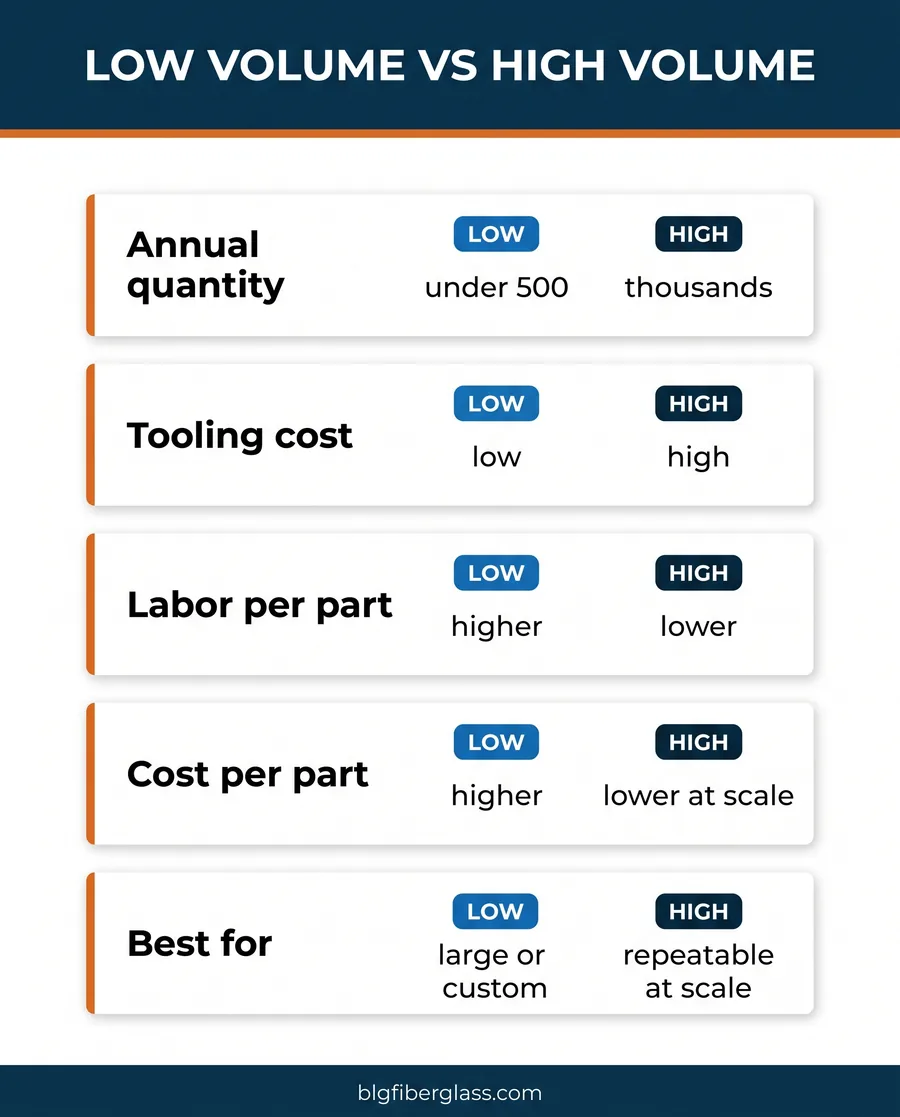
| Factor | Low-volume manufacturing | High-volume manufacturing |
|---|---|---|
| Typical annual quantity | Under ~500 parts | Thousands to tens of thousands |
| Tooling cost | Low (hundreds to a few thousand) | High (tens of thousands and up) |
| Labor per part | Higher, more hand work | Lower, more automated |
| Common processes | Hand lay-up, spray-up, RTM | Compression molding, SMC |
| Cost per part | Higher, flat with volume | Lower once tooling is amortized |
| Best for | Large parts, prototypes, short runs | Repeatable parts at scale |
The cost and quantity ranges above are typical 2026 planning figures and vary widely with part size, geometry, resin system, and finish requirements. They are not a quote. Fiberglass manufacturing also involves resins, hardeners, and airborne particulate handled per each product’s safety data sheet. Confirm actual tooling and unit costs with your manufacturer and follow the SDS for any material you handle.
When low-volume fiberglass manufacturing wins
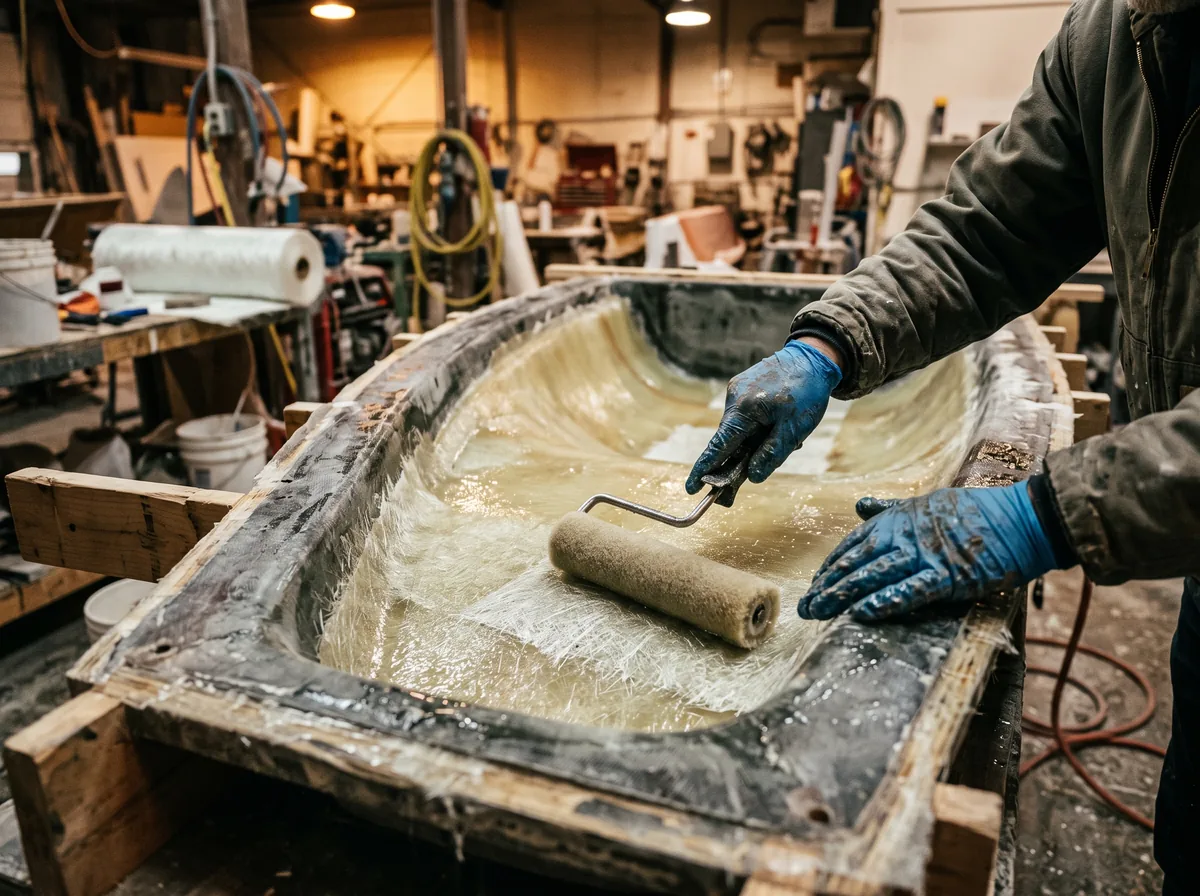
For short runs, large parts, or anything still evolving, low-volume methods are the economical choice. Hand lay-up and spray-up use simple open molds that cost little to build, so you are not amortizing a huge tooling bill across a handful of parts. That makes them ideal for prototypes, custom work, and products that ship in the dozens or low hundreds per year.
Low volume also keeps you flexible. Design changes are cheap when the tooling is cheap, so you can iterate without scrapping a costly mold. For very large single-piece parts like tanks and hulls, open-mold processes are often the only practical route regardless of volume. Our comparison of spray-up and hand lay-up covers how to choose between the two low-volume workhorses.
Quick take
Low volume wins when tooling cost would swamp a short run: prototypes, custom parts, very large single pieces, and products still changing. Cheap, flexible molds beat expensive precision tooling until quantity climbs.
When high-volume makes sense
Once annual quantity climbs into the thousands, the math flips. Processes like sheet molding compound and compression molding use matched metal tooling and can turn out parts in minutes with tight repeatability and excellent surface finish on both sides. The tooling is expensive, but spread across tens of thousands of parts, the cost per unit drops well below anything hand lay-up can reach.
High volume also buys consistency. Automated closed-mold processes reduce the part-to-part variation that hand work introduces, which matters when a customer expects every unit to be dimensionally identical. If your product has stabilized and demand is real, this is where fiberglass manufacturing starts to look like true mass production. The Society of Manufacturing Engineers publishes useful background on how these process economics play out across composites.
Save on unit cost
The single biggest lever on high-volume unit cost is honest quantity forecasting. Commit to real annual numbers and a manufacturer can justify the tooling that slashes per-part cost. Underforecast to avoid tooling spend and you often pay more per part over the product’s life than the tooling would have cost.
The break-even question
The whole decision comes down to a break-even point. High-volume tooling has a large fixed cost but a low cost per part. Low-volume methods have almost no fixed cost but a higher cost per part. Somewhere between them, the total cost lines cross. Below that quantity, low volume is cheaper overall. Above it, high volume wins.
The practical move is to ask your manufacturer to model both at your expected annual quantity, including tooling amortized over the program life, not just a single year. A part that looks marginal in year one often clears the break-even easily once you count three years of production.
People often ask: at what quantity should I switch to high-volume tooling?
There is no fixed number, because it depends on part size and tooling cost, but many composite parts cross the break-even somewhere in the low thousands per year. The right way to find yours is to have a manufacturer model total cost, tooling plus per-part, for both approaches over the full program life at your real volume.
How to decide for your part
Work it in order and the answer usually falls out. Nail down realistic annual volume over the program life, then part size and finish requirements, then ask a manufacturer to price both routes to the same spec.
- Forecast annual quantity honestly across the whole program, not just launch year.
- Note part size: very large single pieces often point to open-mold low-volume methods.
- Define finish needs: two smooth sides push you toward closed-mold or high-volume processes.
- Factor in design stability: if the part is still changing, cheap tooling protects you.
- Ask for a total-cost model of both approaches, tooling amortized over program life.
“We almost skipped the tooling investment to save cash up front. Modeling three years of real volume showed high volume would have paid for itself in eight months. Glad we ran the numbers.”
Operations lead, composites program
Download the free quick guide
A one-page guide to choosing between low-volume and high-volume fiberglass manufacturing.
Frequently Asked Questions
The cheapest process on day one is not always the cheapest over a product’s life. BLG Fiberglass models both routes and manufactures parts at the volume that actually fits your program, for clients across operations in Canada, the Cincinnati area, and manufacturers around Nashville. Send us your volume and part and we will run the numbers with you.
