

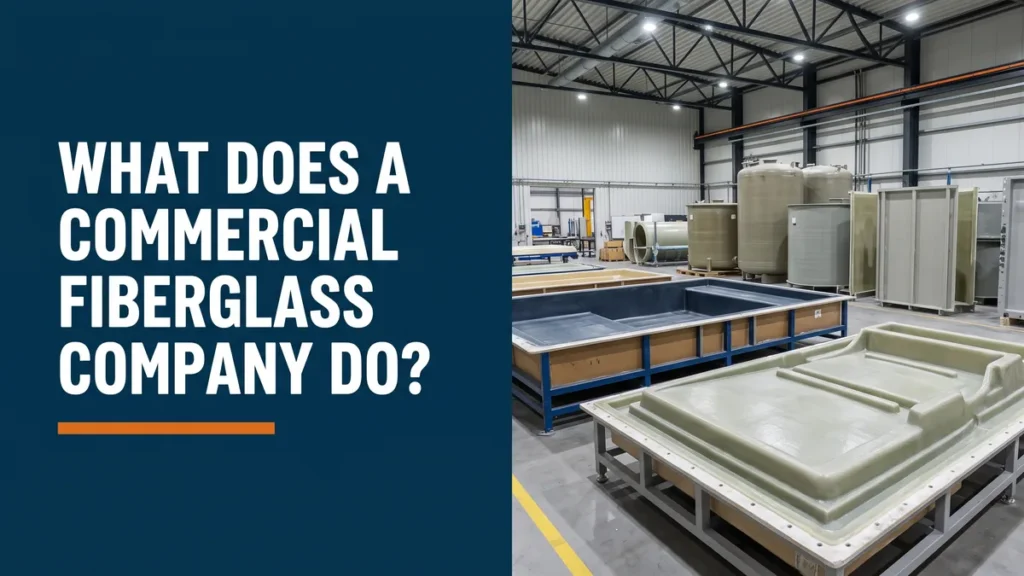
You probably touched three fiberglass parts before lunch without knowing it: a truck panel, an equipment housing, a water tank. A commercial fiberglass company is the manufacturer behind those parts, turning glass reinforcement and resin into finished components for industry. It is a lot more than one process. A serious shop runs several molding methods, from hand lay-up reinforced plastic to automated closed-mold lines, and pairs them with engineering and finishing under one roof.
If you are sourcing composite parts for the first time, the range of services can be confusing. Here is a plain breakdown of what a commercial fiberglass company actually does, so you know what to ask for and how to tell a real manufacturer from a broker who just places your order elsewhere.
In this article
What a commercial fiberglass company does
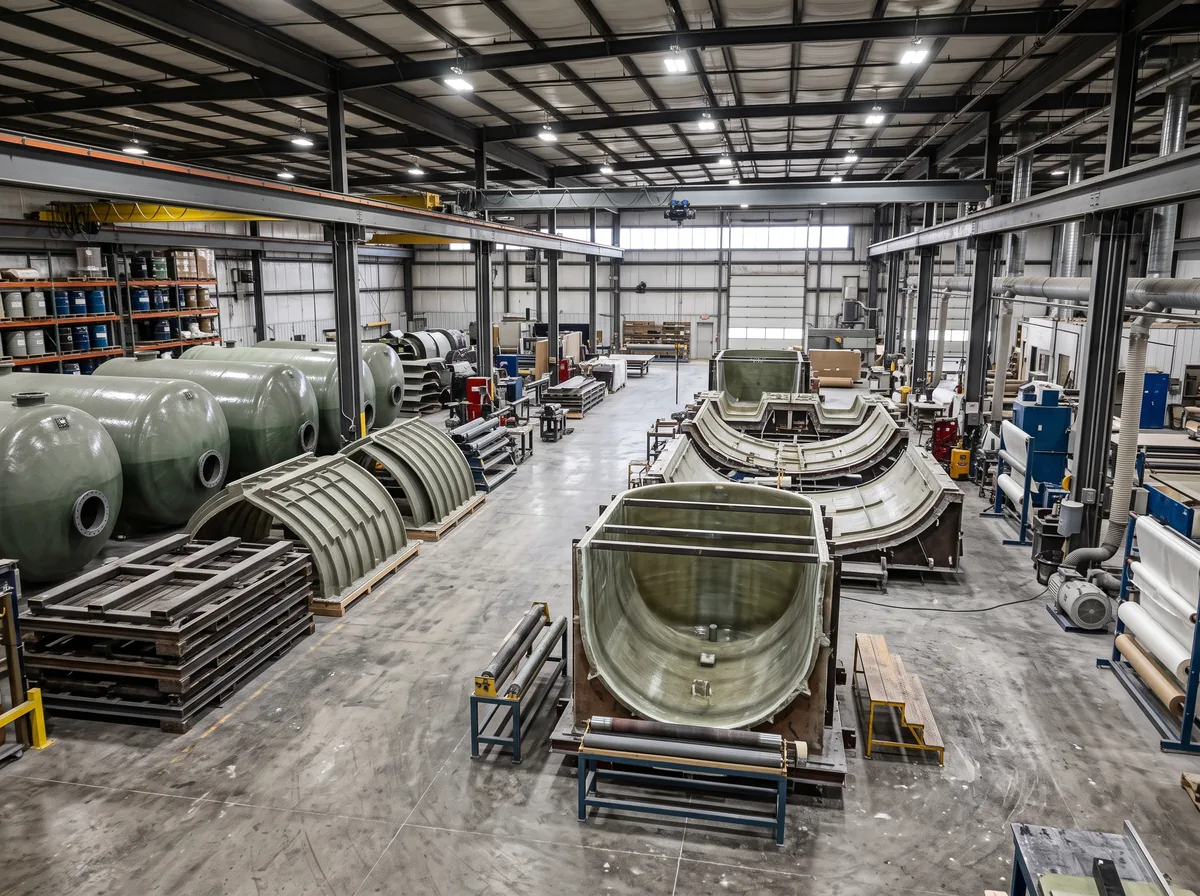
At its core, a commercial fiberglass company designs and manufactures parts from fiber-reinforced polymer, commonly called FRP. That means taking a customer’s requirement, whether a drawing, a sample, or just a problem, and turning it into a repeatable, structural composite part. The work spans tooling, molding, trimming, bonding, and finishing, plus the engineering that decides which resin, reinforcement, and process fit the job.
The reason companies choose composites over metal or injection-molded plastic usually comes down to some mix of corrosion resistance, strength-to-weight, large-part capability, and lower tooling cost at moderate volumes. A good manufacturer helps you land on the right trade-off rather than forcing your part into the one process they happen to own.
Did you know
FRP parts can be far larger than most injection-molded or machined components. Fiberglass molding routinely produces single-piece parts measured in meters, like tanks, enclosures, and vehicle body panels, which would be impractical or impossible to make in one shot any other way.
The core manufacturing processes
The main thing that separates a full-service manufacturer from a one-trick shop is process range. Each method suits a different mix of volume, part size, and finish quality. A capable company will steer you to the right one.
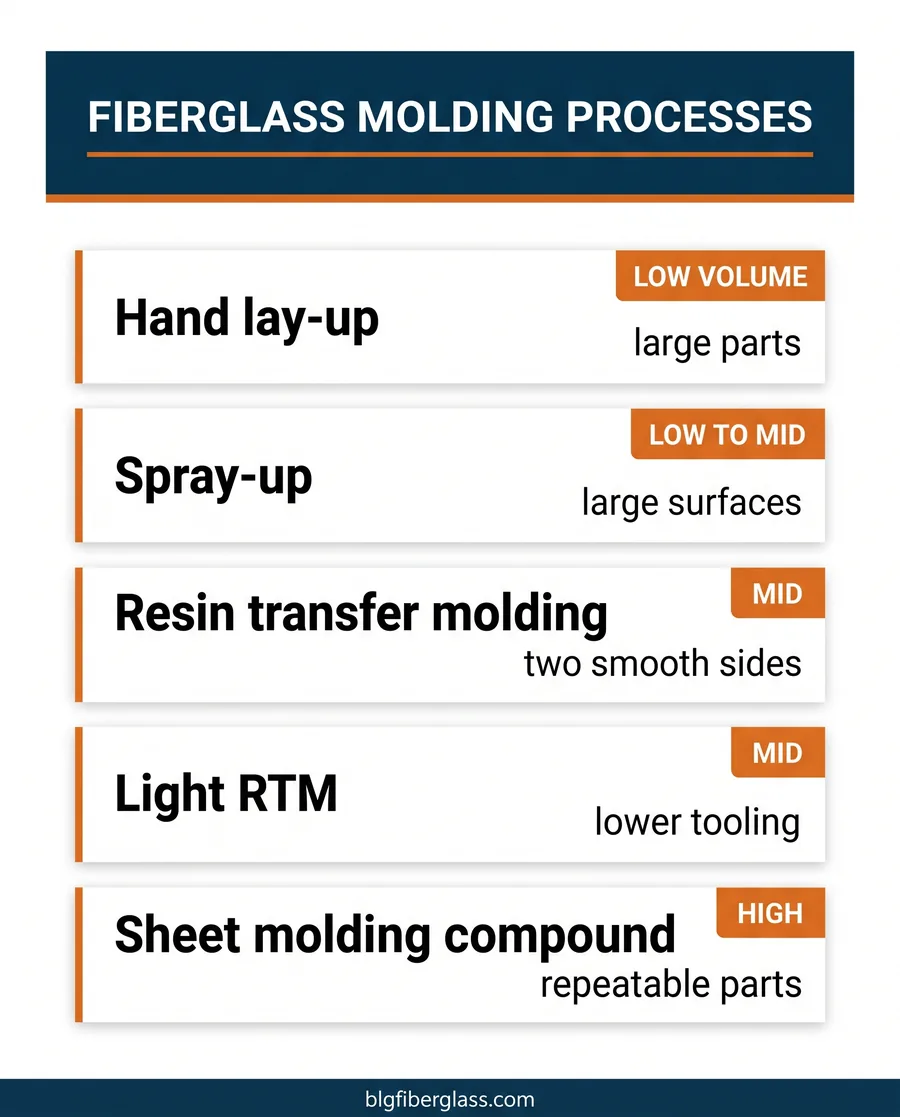
- Hand lay-up fabrication: flexible and cost-effective for large parts and low volumes, with minimal tooling.
- The spray-up process: faster than hand lay-up for covering large, less complex surfaces at low to moderate volume.
- Resin transfer molding: a closed-mold method giving two smooth sides and consistent quality at moderate volume.
- Light resin transfer molding: a lower-tooling-cost closed-mold option for mid volumes.
- Sheet molding compound: compression molding for high-volume parts with tight repeatability.
Choosing among them is a real engineering decision. If you want to go deeper on one common comparison, our guide on spray-up versus hand lay-up walks through the trade-offs. Here is how the processes line up at a glance.
| Process | Volume fit | Typical use |
|---|---|---|
| Hand lay-up | Low, large parts | Tanks, hulls, custom enclosures |
| Spray-up | Low to moderate | Large panels, shower units, covers |
| Resin transfer molding | Moderate | Two-sided smooth structural parts |
| Light RTM | Mid volume | Panels needing good finish, lower tooling |
| Sheet molding compound | High | Repeatable parts, automotive components |
Industries a fiberglass company serves
The same core capability supplies wildly different sectors, because composites solve a common set of problems: weight, corrosion, and complex shapes. A commercial fiberglass company typically serves several of these markets.
- Automotive components: body panels, ducting, and trim where weight and shape flexibility matter.
- Marine parts: hulls, decks, and hardware that must resist salt water and constant flexing.
- Medical equipment housings: enclosures for imaging and diagnostic gear where radiolucency and cleanliness count.
- Oil and gas equipment: tanks, piping, and covers built to survive corrosive environments.
Pro tip
When you evaluate a manufacturer, ask which industries they already serve and for examples close to your part. A shop that has solved corrosion problems for oil and gas or radiolucency for medical will move faster on your job than one learning your requirements from scratch.
Beyond molding: engineering and finishing
Molding is the visible part, but the value often sits on either side of it. On the front end, a good company offers design support: material selection, laminate schedules, and design-for-manufacturability so your part is actually moldable at the volume you need. It also builds the tooling, which is where much of the up-front cost and quality is decided.
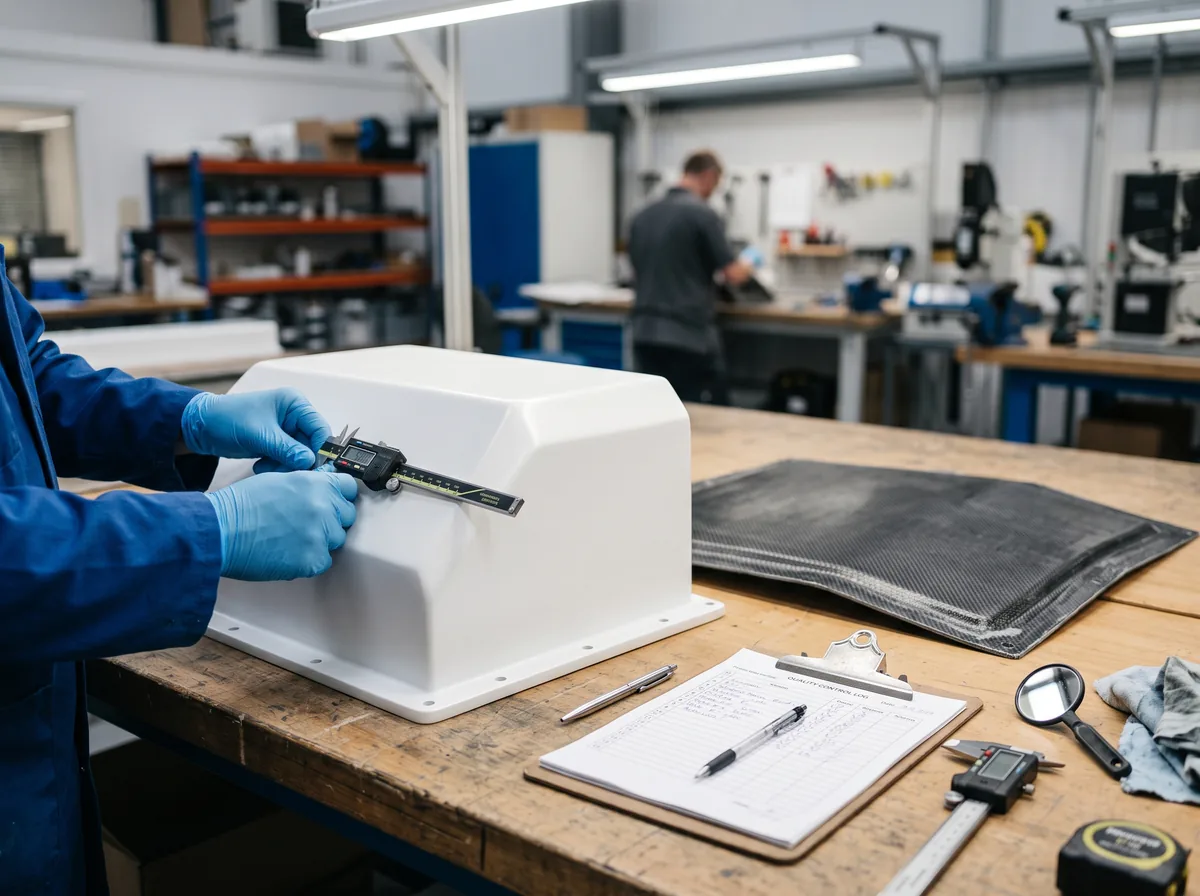
On the back end comes trimming, machining, bonding of sub-assemblies, gel coat and paint, and quality inspection. A full-service manufacturer delivers a finished, inspected component, not a raw molding you still have to process. That handling of reactive resins and airborne particulate is why safety and process control matter as much as the mold itself.
Fiberglass manufacturing involves resins, hardeners, and airborne particulate that require proper ventilation, personal protective equipment, and handling per each product’s safety data sheet. This article is general information only. BLG Fiberglass is not liable for outcomes from actions taken based on it. Always follow the manufacturer’s SDS and consult a qualified professional for your application.
People often ask: does a fiberglass company handle design, or just molding?
The stronger ones handle both. Beyond molding, a full-service manufacturer offers material selection, laminate engineering, tooling, and design-for-manufacturability up front, then trimming, bonding, finishing, and inspection after. You can bring a finished drawing or just a problem. The point of a real manufacturer is that they own the whole path from concept to inspected part.
Telling a manufacturer from a middleman
Not everyone advertising fiberglass parts actually makes them. Some are brokers who take your order and place it with a real shop, adding cost and a layer between you and the people solving your problem. A few questions expose the difference fast: Can I tour your facility? Which processes do you run in-house? Who does the tooling? Can I speak to your engineers? A manufacturer answers these easily. Our guide on vetting a composite fabricator covers the rest of the red flags.
“We spent months dealing with what we thought was our manufacturer. Turned out they outsourced every mold. Once we went direct to the shop, lead times and quality both improved overnight.”
Procurement manager, industry forum
Download the free quick guide
A one-page reference to what a full-service fiberglass company delivers.
Frequently Asked Questions
If you are weighing whether composites fit your product, the fastest way to find out is to talk to the people who mold them. BLG Fiberglass manufactures FRP components across several processes for clients in markets across Canada, the Charlotte area, and manufacturers around Dallas. Bring us your part or your problem and we will tell you the right way to build it.
