

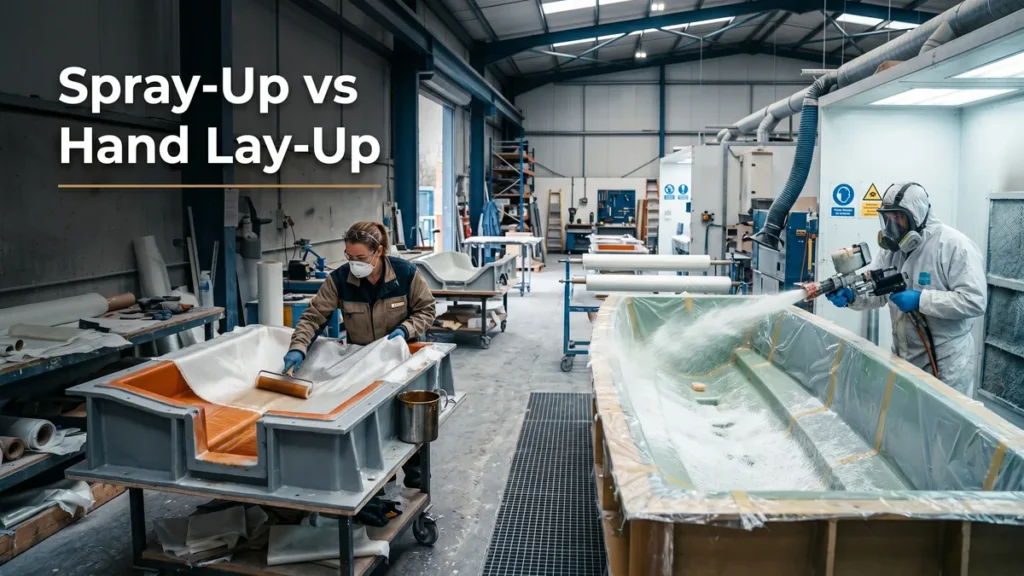
Should you spray it or lay it up by hand? For most open-mold fiberglass parts the answer comes down to three things: how many you need, how much structural strength the part has to carry, and how tight your cost target is. Spray-up is faster and cheaper per part for moderate-strength shapes, while hand lay-up fiberglass fabrication gives you control over fiber orientation and the higher strength-to-weight that demanding parts need. The right call depends on the part, not on which process is “better” in the abstract.
Both are open-mold contact processes that build laminates from glass reinforcement and a thermoset resin. What changes is how the glass gets there and how much say you have over where it ends up. This guide breaks down the difference the way a fabricator weighs it on the shop floor.
In this article
The two processes at a glance
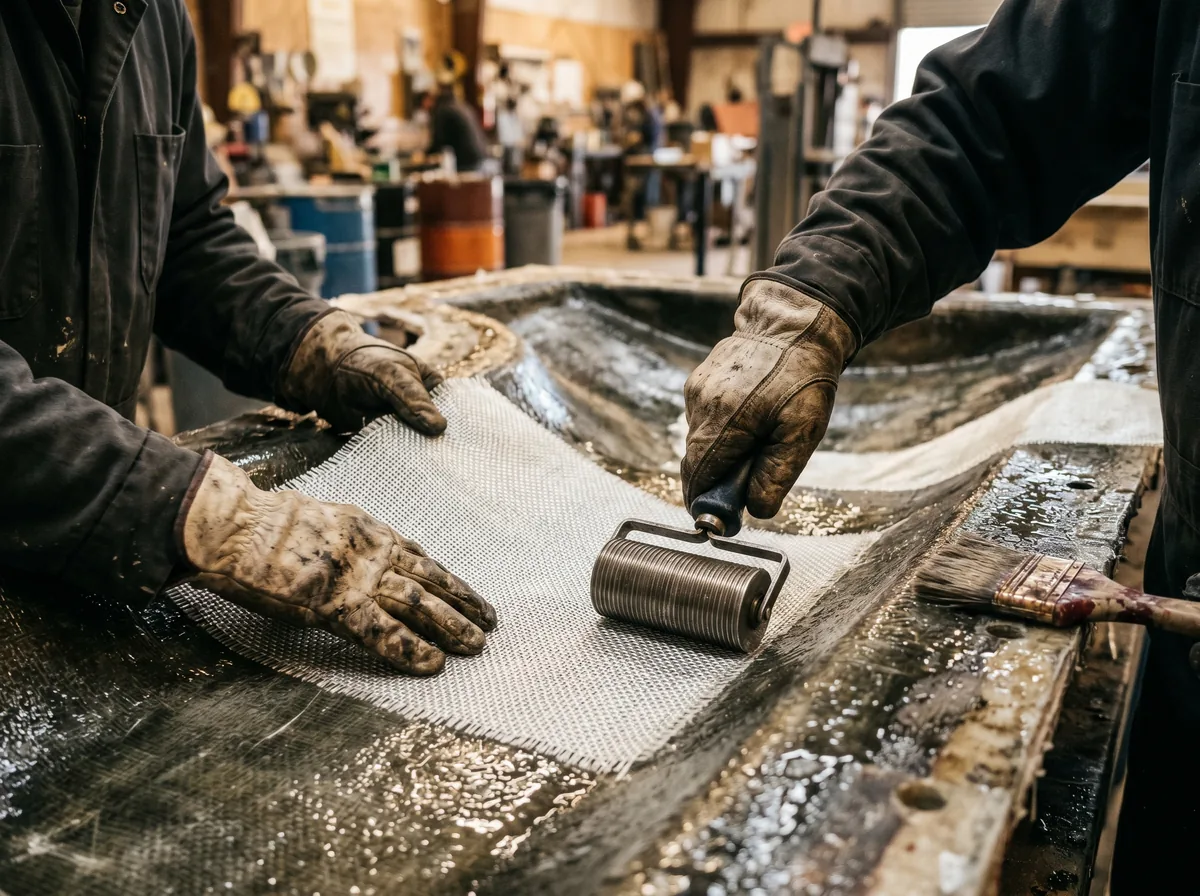
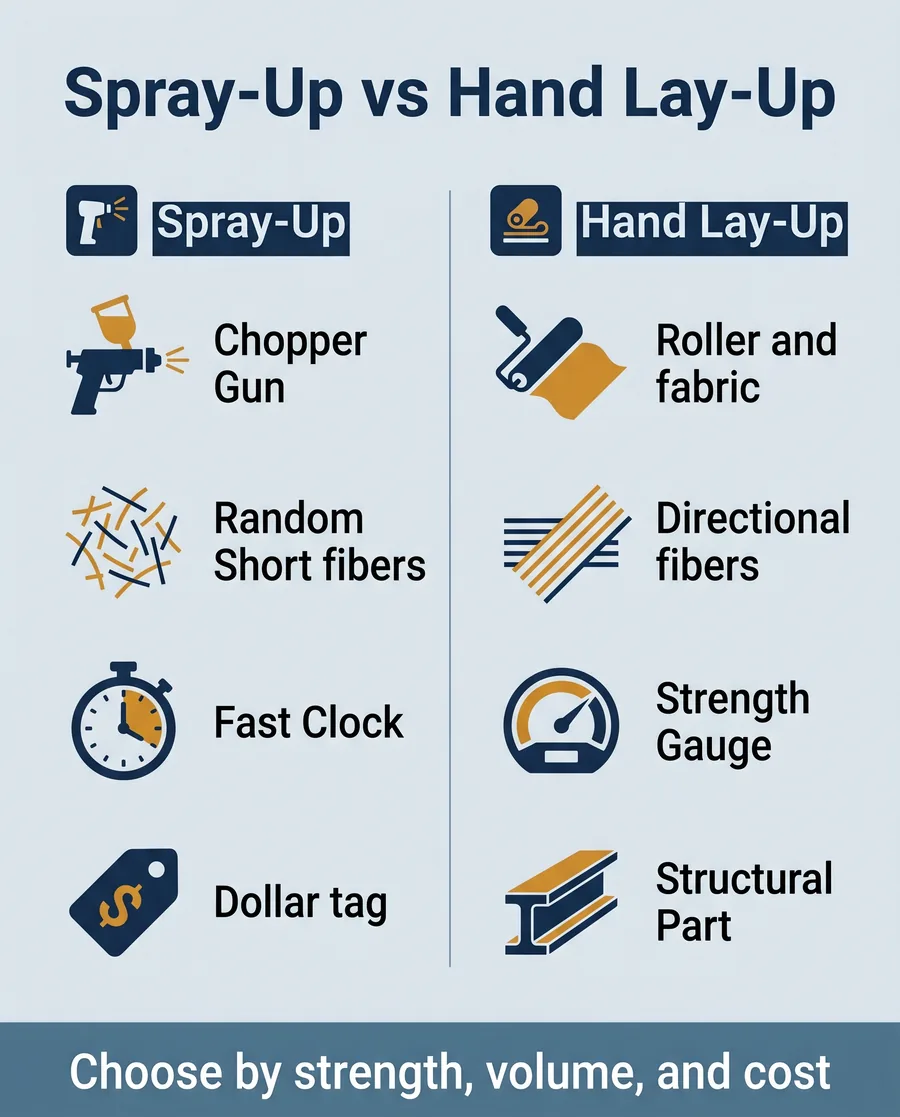
In hand lay-up, a laminator places dry reinforcement (chopped strand mat, woven roving, or stitched fabric) into the mold by hand, then wets it out with catalyzed resin using brushes, rollers, and squeegees. Because the glass is placed deliberately, you can orient woven and stitched plies to carry load in a specific direction and build a tailored laminate schedule ply by ply.
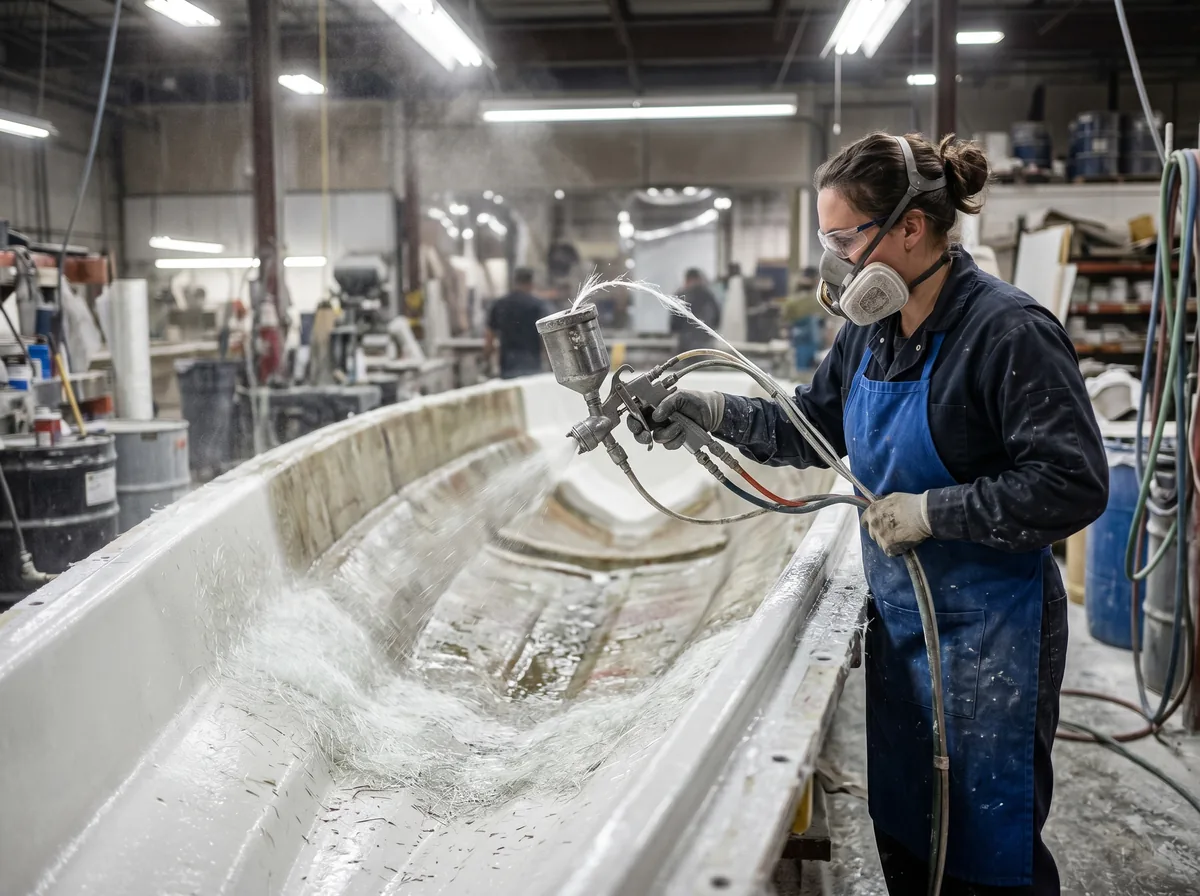
In spray-up, a chopper gun cuts continuous glass roving into short strands and sprays them onto the mold at the same time as the catalyzed resin. An operator then rolls out the deposit to consolidate it and remove air. The glass lands in random orientation, which makes the process fast but gives the laminate roughly equal, and lower, strength in every direction.
Quick take
Need many moderate-strength parts fast and cheap? Spray-up. Need high strength-to-weight, directional reinforcement, or thicker structural sections? Hand lay-up. Many real shops use both, sometimes on the same part.
Spray-up vs hand lay-up: side by side
The table below summarizes how the two open-mold processes compare on the factors that usually drive a sourcing decision. Treat these as general tendencies; actual results depend on the resin system, glass content, and how well the laminate is consolidated.
| Factor | Spray-up (chopped) | Hand lay-up |
|---|---|---|
| Glass orientation | Random, short fibers | Directional, placed by hand |
| Typical glass content | Lower (around 25 to 35 percent) | Higher (around 35 to 50 percent) |
| Strength-to-weight | Moderate | High |
| Cycle time per part | Fast | Slower, labor intensive |
| Labor skill required | Moderate (gun control) | High (laminating skill) |
| Tooling cost | Low (open mold) | Low (open mold) |
| Best production volume | Low to medium, repeat parts | Low volume, prototypes, structural parts |
| Thick or load-bearing sections | Limited | Strong fit |
| Surface and consistency | Operator dependent | Operator dependent, finer control |
Pro tip: read the glass-to-resin ratio, not just the process name
A well-run spray-up part can outperform a sloppy hand lay-up, and the reverse is just as true. The single biggest driver of laminate strength is the glass-to-resin ratio and how thoroughly the laminate is rolled out to remove voids. When you compare quotes, ask each fabricator for the target glass content and how they verify consolidation, not only which process they run.
How the two compare on strength and quality
Engineering note: This article is general guidance for industrial buyers and fabricators. It is not a substitute for project-specific engineering. The right process, resin system, and laminate schedule depend on your loads, chemistry, temperature, and the standards that govern your application. Confirm any material or process decision with a qualified composites engineer and the relevant code (for example ASTM, ASME RTP-1, or NACE/AMPP) before you commit to production.
The mechanical difference traces back to the fibers. In spray-up, the glass is chopped into short, randomly oriented strands, so the laminate has modest, even properties in every direction. That is fine for non-structural panels, enclosures, low-pressure tanks, and cosmetic parts where one side is hidden.
Hand lay-up uses continuous reinforcement, woven roving and stitched fabrics, that a laminator aligns with the primary loads. That alignment delivers high strength-to-weight and lets engineers design a laminate schedule for a specific stress case. Industry references such as the ASTM composite materials standards define the test methods used to confirm those properties when a part has to pass qualification.
People often ask: is hand lay-up always stronger than spray-up?
Not automatically, but for the same part and resin it usually is, because continuous, oriented fibers carry load better than chopped random ones and because hand laminates tend to run higher glass content. The honest answer is that strength depends on the laminate, not the label. A thin, resin-rich hand lay-up can be weaker than a dense, well-consolidated spray-up part. Specify the property you need and let the fabricator pick the process that hits it.
Cost, volume, and tooling reality
Both processes are open-mold, so tooling is inexpensive next to closed-mold methods. You can produce large parts without the high upfront cost of matched metal tooling. Where they split is labor and throughput.
- Spray-up wins on speed. A chopper gun lays down material far faster than a laminator placing fabric by hand, which lowers cost per part once a part is in repeat production.
- Hand lay-up wins on control. Slower and more labor-intensive, but you get directional strength, cleaner thick sections, and consistent results on parts that matter structurally.
- Both depend on operator skill. Neither process is automated, so consistency comes from the people running it. That is why fabrication experience matters more than the process name.
When volumes climb or strength and surface demands rise beyond what open molding handles cost-effectively, shops move to closed-mold methods such as resin transfer molding or sheet molding compound. Knowing where open molding ends and closed molding begins is part of getting the quote right.
Which process fits which project
Use this as a starting point when you scope a part, then confirm with a fabricator who can see your drawings and loads.
- Choose spray-up when the part is moderate-strength, you need repeat quantities at a low unit cost, one face is hidden, and shape complexity is moderate. Think enclosures, low-pressure tanks, ducting, and large cosmetic panels.
- Choose hand lay-up when the part is structural, needs directional reinforcement, has thick or highly contoured sections, or runs in low volume or as a prototype. Think structural housings, large marine components, and wind turbine parts where strength-to-weight is critical.
- Step up to closed molding when you need both faces finished, higher and repeatable glass content, tighter tolerances, or higher volumes than open molding supports economically.
Edge cases and hybrid approaches
The two processes are not mutually exclusive. A common, practical approach is to spray-up a base skin coat for speed and a clean mold surface, then reinforce with hand-laid woven roving in the high-stress zones. You get the throughput of spray-up where the part is simple and the directional strength of hand lay-up where the loads concentrate.
Resin choice cuts across both. Polyester is the economical default, vinyl ester steps up corrosion resistance, and epoxy delivers the best mechanical performance at a higher cost. The same part can be built either way in any of these resins, so specify performance targets and let the fabricator map process and resin to the result. If you are unsure, our fabrication team can walk a drawing with you.
Sources and further reading
- ASTM International, composite materials standards and test methods (astm.org).
- American Composites Manufacturers Association, Composites Manufacturing resources (compositesmanufacturingmagazine.com).
- BLG Fiberglass, in-house fabrication experience across open-mold and closed-mold processes.
- TE&MC, “Producing fiberglass composites by hand and spray layups” (video, embedded above).
Frequently asked questions
Is spray-up or hand lay-up cheaper?
For repeat parts of moderate strength, spray-up is usually cheaper per part because the chopper gun deposits material much faster than a laminator placing fabric by hand. The labor saving adds up over a production run. Hand lay-up costs more per part because it is slower and demands higher skill, but it buys you directional strength and control that spray-up cannot match. Tooling cost is similar since both are open-mold processes. For a true comparison, price a specific part with a defined glass content rather than comparing the processes in the abstract.
Which process gives stronger fiberglass parts?
Hand lay-up generally produces stronger parts for the same design because it uses continuous, oriented reinforcement and typically runs a higher glass-to-resin ratio. The laminator can align woven and stitched plies with the primary loads, which raises strength-to-weight where it counts. Spray-up uses short, randomly oriented chopped glass, so its strength is moderate and roughly equal in all directions. That said, a well-consolidated spray-up part can beat a poorly built hand lay-up, so the laminate quality and glass content matter as much as the process name.
Can you combine spray-up and hand lay-up on one part?
Yes, and fabricators do it often. A practical hybrid sprays a base layer for speed and a clean molded surface, then adds hand-laid woven roving in the areas that carry the most load. This gives you the throughput of spray-up on the simple sections and the directional strength of hand lay-up where the part needs it. The approach works well on large parts with localized stress concentrations. Discuss it with your fabricator early, because where the reinforcement goes should follow the part’s actual load paths, not a generic recipe.
When should I move from open molding to a closed-mold process?
Consider closed-mold methods such as resin transfer molding or sheet molding compound when you need both faces finished, higher and more repeatable glass content, tighter tolerances, lower emissions, or production volumes that open molding cannot serve economically. Open molding stays attractive for large parts, low volumes, and prototypes because tooling is inexpensive. The crossover point depends on your annual quantity, part size, and quality requirements. A fabricator who runs both open and closed processes can tell you where your specific part lands and quote each path so you can compare.
The verdict
Bottom line
Spray-up is the faster, lower-cost route for moderate-strength parts in repeat quantities; hand lay-up is the route for directional strength, thick sections, and structural parts. Specify the performance you need, then let an experienced fabricator pick, or blend, the process that hits it.
Download the free quick guide
A one-page checklist of the questions to answer before you choose spray-up or hand lay-up for your part.
Not sure which fiberglass process your part needs?
BLG Fiberglass fabricates custom fiberglass and FRP parts across both open-mold and closed-mold processes for industrial, marine, and energy customers. Send us your drawings or talk to our fabrication team and we will recommend the process, resin, and laminate that fit your loads, volume, and budget.
