
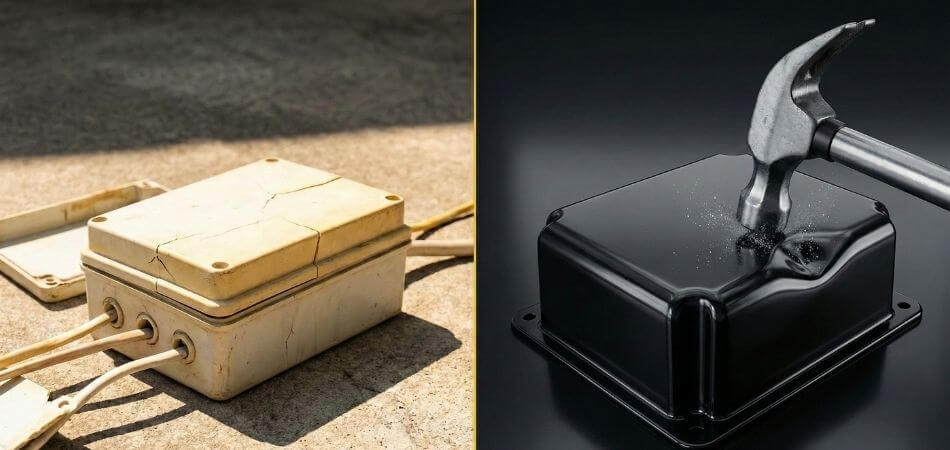
Why is your outdoor enclosure cracking after six months? Or why did that prototype shatter when dropped from a workbench? If you’re asking these questions, you’re likely battling the “Triangle of Trade-offs” in thermoplastic selection: Cost, Toughness, and Weatherability.
At BLG Fiberglass, we see this constantly in our vacuum forming projects. You want the price of HIPS, the molding ease of ABS, and the bulletproof nature of Polycarbonate. Spoiler alert: You can’t have all three perfectly, but you can get very close if you know how to manipulate material grades.
Here is the no-nonsense breakdown of how High Impact Polystyrene (HIPS), Acrylonitrile Butadiene Styrene (ABS), and Polycarbonate (PC) actually perform when the sun hits them and things hit them.
HIPS vs ABS vs PC: The Impact Showdown
When we talk about impact resistance, we aren’t just talking about hardness. We are talking about energy absorption—how much force a material can take before catastrophic failure.
1. High Impact Polystyrene (HIPS)
The Budget Contender. HIPS is modified polystyrene with rubber (butadiene) added to make it less brittle.
- The Reality: It’s strictly “okay.” It handles minor bumps and normal handling well. However, if you drop a heavy HIPS enclosure on a concrete floor in freezing temperatures, it’s likely going to crack.
- Best For: Point-of-purchase displays, indoor signage, and low-stress covers.
2. ABS (Acrylonitrile Butadiene Styrene)
The Industry Workhorse. ABS is the standard for a reason. The butadiene rubber component gives it excellent shock absorbance.
- The Reality: ABS will dent or deform before it shatters. It has significantly higher impact strength than HIPS. It feels rigid, solid, and “premium” to the touch.
- Best For: Dashboard components, luggage, protective cases, and housings that need to survive daily abuse.
3. Polycarbonate (PC)
The Heavyweight Champion.Polycarbonate is effectively transparent steel. It is virtually unbreakable in standard applications.
- The Reality: Its impact resistance is roughly 30x that of acrylic and significantly higher than ABS. You can take a sledgehammer to a thick sheet of Polycarbonate, and it will likely just bounce back.
- Best For: Riot shields, heavy machinery guards, automotive exterior parts, and anything where failure is not an option.
The Sun Factor: UV Resistance and “Chalking”
This is where the conversation usually gets expensive. Standard plastics hate the sun. UV radiation breaks down polymer chains, leading to yellowing (esthetic failure) and brittleness (structural failure).
The “Naked” Truth
- HIPS: Poor UV resistance. It yellows quickly and becomes brittle. It is almost exclusively an indoor material unless painted or coated.
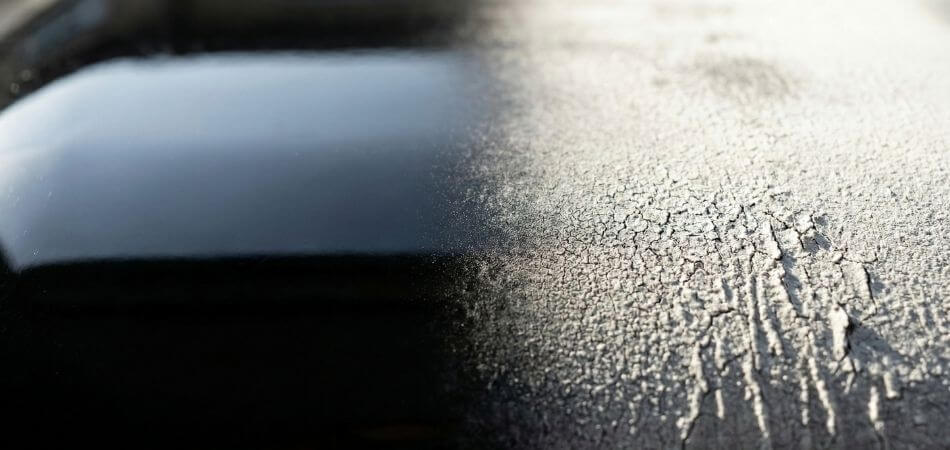
- ABS: Standard ABS is not UV stable. If you leave raw black ABS in the sun, it will turn a hazy gray/white (chalking) and lose its impact strength within months.
- Polycarbonate: Better than ABS, but standard PC will still yellow and haze over time without UV stabilizers.
The Solution: Co-Extrusion and Cap Layers
If you need the cost effectiveness of ABS but the weatherability of a premium material, you don’t always have to jump to Polycarbonate.
In vacuum forming, we often use Co-extruded ABS. This is a sheet of ABS with a thin top layer (cap) of a UV-resistant polymer like ASA (Acrylonitrile Styrene Acrylate) or Acrylic.
Why do this? You get the structural toughness of the ABS core. You get the UV immunity of the ASA cap. And you pay a fraction of the price of solid Polycarbonate.
Cost vs. Performance Matrix
Sometimes the engineering requirements are clear, but the budget disagrees. When selecting the right thermoplastic sheet, here is how they stack up on the invoice:
| Material | Relative Cost | Impact Strength | UV Stability (Raw) | Thermoforming Ease |
| HIPS | $ (Low) | Low/Medium | Poor | Excellent |
| ABS | $$ (Mid) | High | Poor | Excellent |
| PC | (High) |
Extreme | Fair/Good | Difficult (Needs drying) |
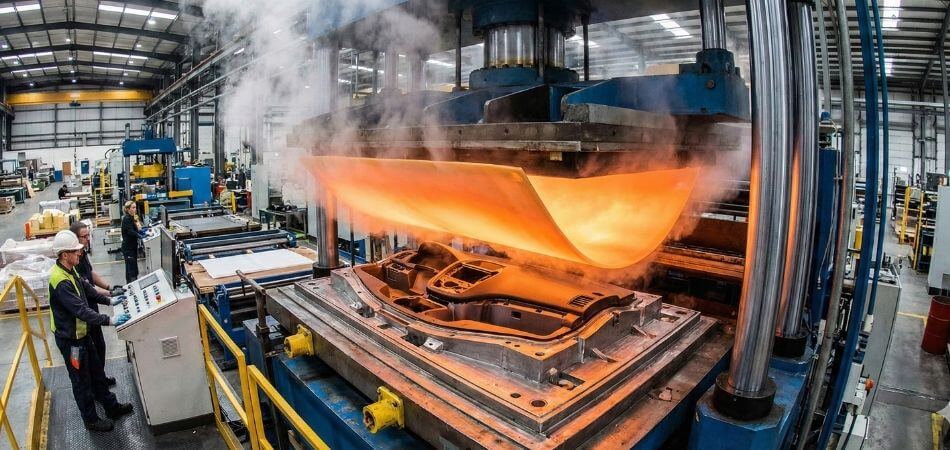
Important Manufacturing Note: Polycarbonate is hydroscopic. It absorbs moisture from the air. Before we can vacuum form it, we have to pre-dry the sheets in an oven for hours. If we don’t, the moisture boils instantly during molding, creating bubbles in the plastic. This adds time and labor costs to PC parts that ABS and HIPS don’t usually incur.
When to Upgrade to “Exotics”?
Sometimes the “Big Three” aren’t enough.
Fire Rating: If you need UL94 V-0 flammability ratings (self-extinguishing), you are almost certainly looking at FR-ABS or Polycarbonate. HIPS burns readily.
Chemical Resistance: If your part is used in a hospital and wiped down with harsh cleaners daily, ABS might crack due to chemical stress. You might need to look at Kydex (an Acrylic/PVC alloy) or simpler materials like HDPE or PETG, though they have their own forming challenges.
Which Material Wins?
There is no single winner, only the right tool for the job.
- Choose HIPS if: You are making disposable displays, indoor prototypes, or low-stress covers where budget is the #1 priority.
- Choose ABS if: You are building durable housings for indoor electronics or machinery. If it’s going outside, specify UV-Capped ABS (ASA/ABS). This is the “sweet spot” for 80% of our industrial clients.
- Choose Polycarbonate if: The part will be subjected to high heat, extreme impact (vandalism prone), or requires transparency. Just be prepared for the higher raw material and processing costs.
Don’t guess with your tooling budget. At BLG Fiberglass, we handle everything from heavy-duty fiberglass composites to precision vacuum-formed thermoplastics. We can look at your CAD design and environment specs to tell you exactly which resin will survive.
Ready to start your production run? Contact BLG Fiberglass today for a material consultation and quote.
