
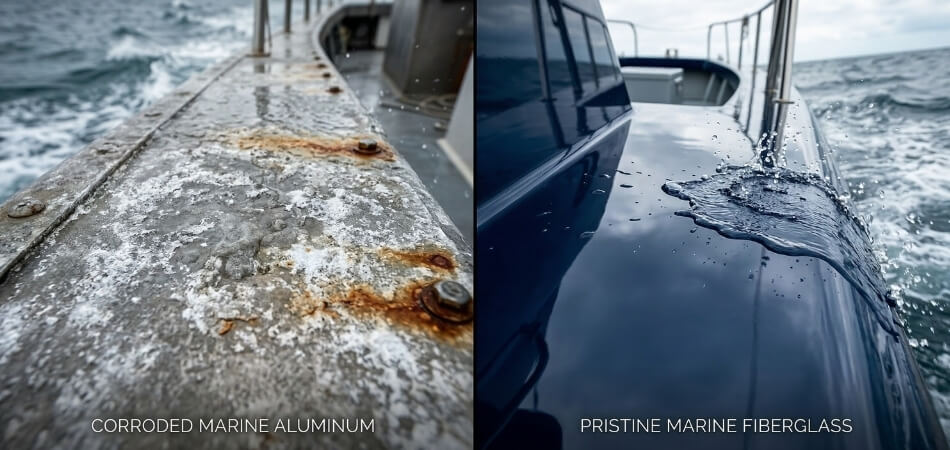
Marine and industrial sectors are shifting from aluminum to fiberglass because fiberglass is completely immune to galvanic corrosion and electrolysis. While aluminum requires expensive coatings and sacrificial anodes to survive saltwater or chemical environments, fiberglass (FRP) offers a maintenance-free lifespan that often exceeds 50 years. This transition is driven by the significantly lower life cycle costs and superior chemical resistance of composite materials.
Why is Aluminum vs Fiberglass Corrosion Such a Big Deal in Saltwater?
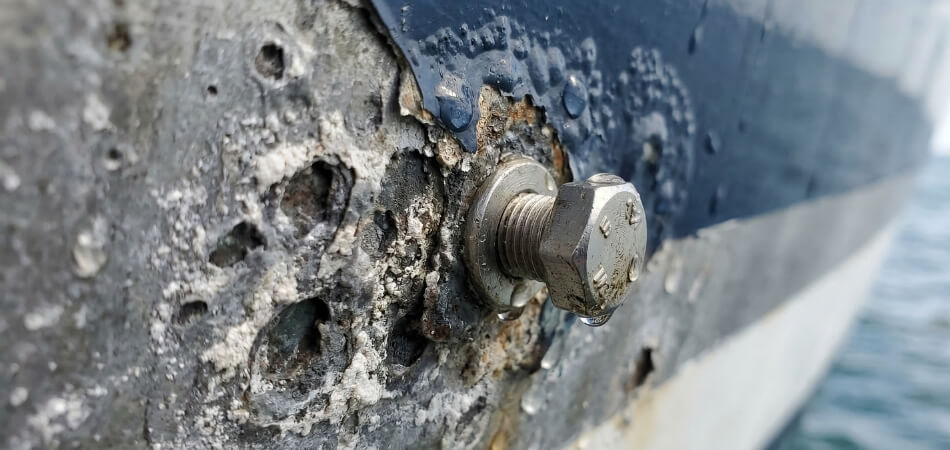
Aluminum is often praised for being lightweight, but it has a fatal flaw in marine environments. It is a highly active metal on the galvanic scale. When aluminum comes into contact with more noble metals (like stainless steel fittings) in the presence of an electrolyte like seawater, it begins to sacrifice itself through a process called galvanic corrosion.
Fiberglass is a non-conductive composite. It does not participate in the electrochemical reactions that destroy metal. This means you do not have to worry about “white rust” or pits forming in your enclosures or structural components just because they are near the ocean.
The industrial sector faces similar challenges. Chemical plants deal with caustic fumes that can eat through an aluminum electrical box in months. Fiberglass applications in key industries have proven that composites can withstand pH levels that would dissolve metallic alternatives.
What is the Real Cost Difference Between Aluminum and Fiberglass?
Many procurement officers look only at the “sticker price” of the raw material. While aluminum might seem cheaper upfront, the maintenance overhead is a silent profit killer. You have to factor in painting, specialized coatings, and the labor required for constant inspections.
Fiberglass is “set it and forget it.” It does not require painting because the color is typically embedded in the gel coat or resin itself. We have compiled a comparison of the long-term factors below.
| Feature | Aluminum (5052/6061) | Fiberglass (FRP/GRP) |
|---|---|---|
| Corrosion Resistance | Requires coatings/anodes | Naturally immune |
| Conductivity | Highly conductive (Risky) | Non-conductive (Insulator) |
| Maintenance | High (Cleaning/Painting) | Negligible |
| Weight | Lightweight | Ultra-lightweight |
| Impact Recovery | Dents and deforms | Flexes and returns to shape |
Does Galvanic Corrosion Affect Industrial Enclosures?
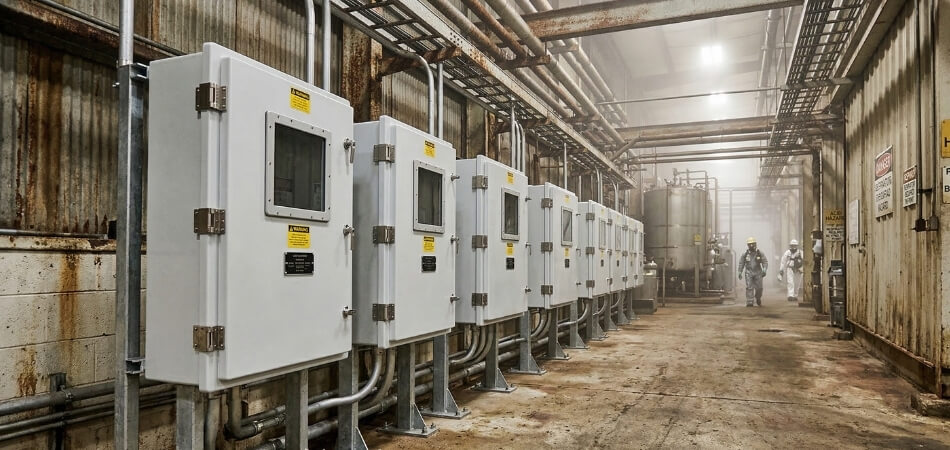
Yes, especially in facilities with high humidity or chemical washdowns. In an industrial setting, aluminum enclosures often fail at the points where they are bolted to steel racks. This “dissimilar metal” contact creates a battery-like effect that accelerates decay.
Fiberglass eliminates this risk entirely. Because it is an electrical insulator, it also provides an extra layer of safety for workers. It prevents the enclosure itself from becoming “energized” in the event of an internal electrical fault.
If you are managing a facility, you should understand the different types of fiberglass resins used to combat specific acids or bases. Choosing the right resin ensures your equipment survives even the harshest industrial “rain.”
How Does the Strength-to-Weight Ratio Compare?
A common misconception is that fiberglass is “weaker” than metal. In reality, pound-for-pound, fiberglass can be stronger than aluminum. This is particularly true when you look at specific strength.
- Aluminum has a density of approximately 2.7g/cm³.
- Fiberglass typically ranges between 1.5 and 2.0g/cm³.
- Fiberglass can be engineered with specific fiber orientations to handle loads in one direction, much like the grain in wood.
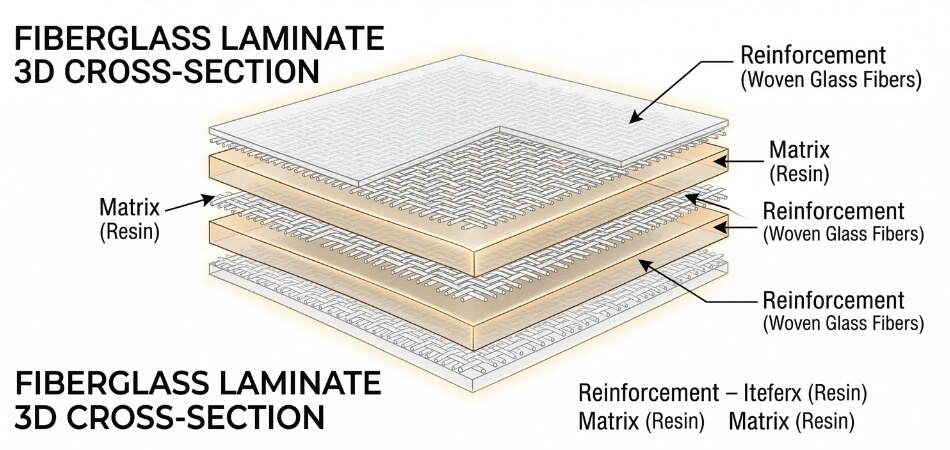
This weight savings is a massive advantage for offshore oil rigs. Reducing the “topside weight” of an offshore platform allows for more equipment or better stability. In the definition of Fiber-Reinforced Plastic (FRP), the synergy between the glass fibers and the polymer matrix provides a toughness that metals simply cannot replicate without adding significant mass.
Why are Marine Engineers Choosing FRP Over Aluminum?
Beyond the corrosion issue, marine engineers are looking at thermal properties. Aluminum is a massive heat conductor. In the sun, an aluminum hatch or enclosure becomes hot enough to burn skin and can cook the electronics inside.
Fiberglass has low thermal conductivity. It acts as a natural insulator, keeping internal temperatures stable. This reduces the load on cooling systems and extends the life of sensitive marine electronics. It is also transparent to radio waves, which is vital for housing radar or GPS equipment.
Is Fiberglass Sustainable for Long-Term Infrastructure?
- Life Extension: Fiberglass structures often last 2 to 3 times longer than aluminum in coastal zones.
- Reduced Chemical Use: No need for toxic anti-corrosion paints or primers that can leach into the ocean.
- Energy Efficiency: Lighter weight means lower fuel consumption for marine vessels.
The Final Verdict: Making the Switch to Composites
The data is clear. While aluminum has served the industry well for decades, the costs associated with aluminum vs fiberglass corrosion are becoming unsustainable. As we move toward more remote, offshore, and automated industrial environments, the need for “zero-maintenance” materials is paramount.
If you are still using aluminum for your marine or industrial enclosures, you are likely paying a “corrosion tax” every year in the form of maintenance and premature replacements. Switching to fiberglass is not just a material change; it is a financial strategy to protect your assets for the next half-century.
Would you like me to provide a custom quote or a material durability analysis for your specific industrial application?
